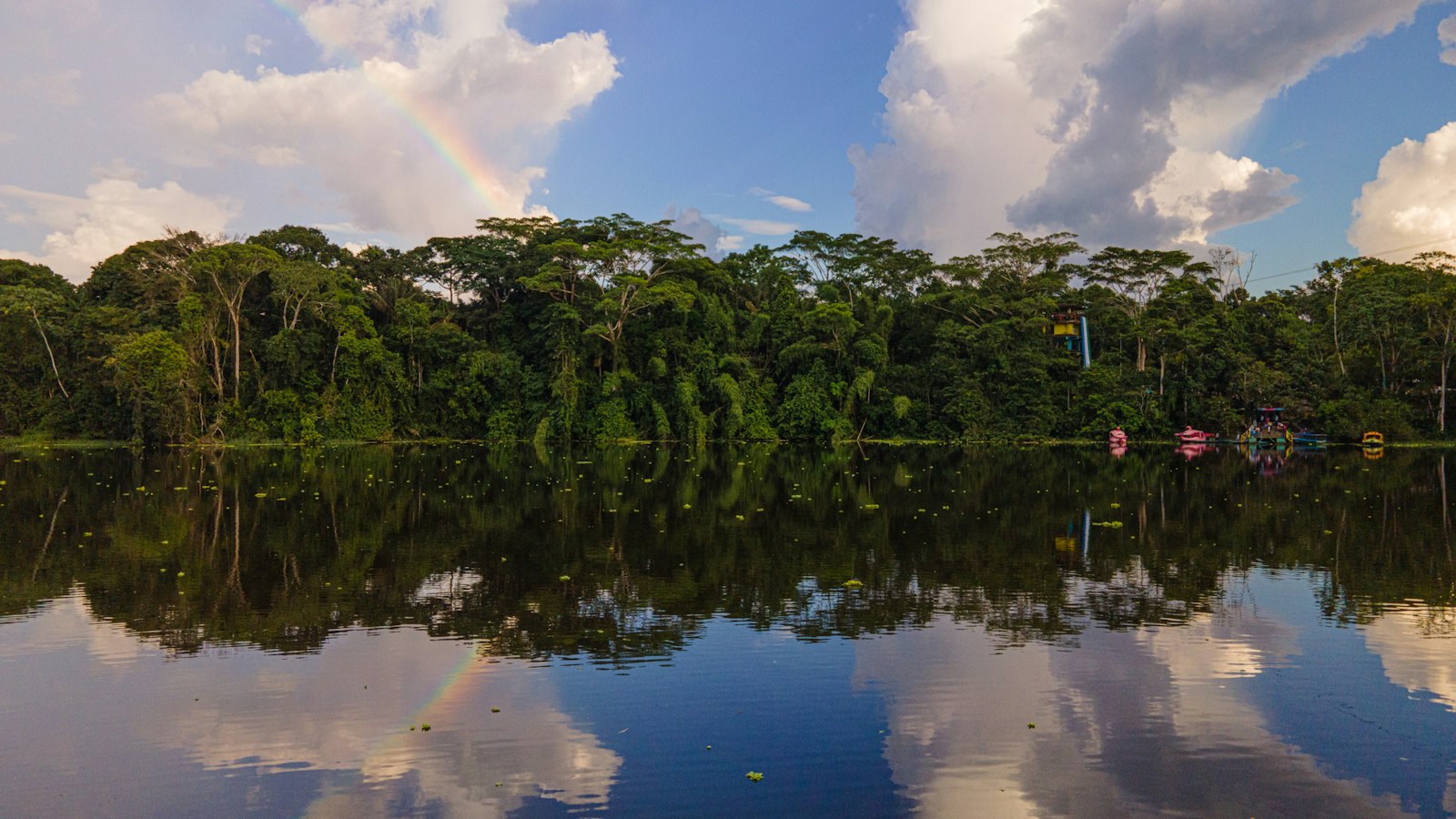
From 30 December 2026, Brazilian soya, beef, coffee, cocoa, wood, rubber and palm oil can only enter the EU market with proof that they were not grown on land deforested after 2020. The EU Deforestation Regulation (EUDR) turns that promise into a legal requirement, backed by plot-level geolocation, satellite checks and penalties of up to 4% of EU turnover.
This guide to EUDR compliance for Brazil in 2026 explains the benchmarking rules, the geolocation and polygon requirements, how Brazilian monitoring systems such as PRODES, DETER and MapBiomas fit in, and where the RenovaBio programme and its CBIO credits sit alongside EU rules. It ends with a step-by-step traceability protocol and audit checklist. For a short visual overview, see the 11-slide Amazon bioeconomy web story; to quantify the carbon stored on a plot, use our Carbon Stock Calculator.
- What the EUDR requires
- What changed in December 2025 and May 2026
- Benchmarking: why Brazil is standard risk
- Covered commodities and Brazil’s exposure
- Geolocation and polygon rules
- PRODES, DETER and MapBiomas
- Proving legality in Brazil
- RenovaBio and CBIOs
- Traceability protocol
- Audit checklist
- Common mistakes
- FAQs
What the EUDR requires
Regulation (EU) 2023/1115 prohibits placing relevant products on the EU market, making them available or exporting them unless three conditions are all met:
- Deforestation-free: the commodity was produced on land that has not been deforested after 31 December 2020 (and, for wood, harvested without forest degradation after that date).
- Legal: it was produced in line with the relevant laws of the country of production, including land-use rights, environmental protection, labour and human rights, the rights of indigenous peoples, tax and anti-corruption rules.
- Covered by a due diligence statement (or, for qualifying micro and small primary operators, a simplified declaration) submitted through the EU Information System.
Operators carry the main duty. They must collect information including plot geolocation and production dates, assess the risk of non-compliance, and mitigate any risk that is not negligible before submitting a due diligence statement (DDS). Penalties set by member states must include fines of up to at least 4% of the operator’s total annual EU turnover, confiscation of products and revenues, and temporary exclusion from public procurement.
EUDR and Brazil at a glance: dates, risk tier and what must be proven
Products must be deforestation-free, legally produced and covered by a due diligence statement before they are placed on, made available on or exported from the EU market.
| Commodity | Example products | Main traceability challenge in Brazil |
|---|---|---|
| Soya | Soybeans, meal, oil | Cerrado and Amazon frontier; indirect sourcing through traders and crushers |
| Cattle | Beef, live cattle, leather | Indirect suppliers (calf-rearing farms) rarely mapped; animals move between farms |
| Coffee | Green and roasted coffee | Many smallholders; point coordinates usually enough below 4 ha |
| Wood | Logs, sawnwood, pulp, paper, furniture | Legality of logging permits and forest management plans |
| Cocoa | Beans, butter, chocolate | Pará and Bahia agroforestry; smallholder mapping |
| Rubber | Natural rubber, tyres | Small volumes; mixed with imports from Asia |
| Oil palm | Palm oil and derivatives | Small share of Brazil’s exports; mostly Pará |
Sources: Regulation (EU) 2023/1115 as amended in December 2025; Commission Implementing Regulation (EU) 2025/1093 (country benchmarking); Commission guidance, May 2026. Not legal advice.
What changed in December 2025 and May 2026
The EUDR was adopted in 2023 and was due to apply from December 2024, but it has been delayed twice. A December 2025 amendment set the current dates and lightened several obligations; a Commission simplification review followed on 4 May 2026 (European Commission).
- Application dates: 30 December 2026 for large and medium-sized companies and for micro and small enterprises already covered by the EU Timber Regulation; 30 June 2027 for all other micro and small enterprises.
- Responsibility moves upstream: due diligence sits with the first operator that places a product on the EU market. Downstream operators and traders keep information on their direct business partners and the DDS reference numbers, and non-SMEs register in the Information System.
- Micro and small primary operators in low-risk countries need only a one-time simplified declaration. This route is not available to producers in Brazil, which is standard risk.
- Product scope: a draft delegated act would add products such as soluble coffee and some palm oil derivatives, and remove cattle hides and skins and retreaded tyres. It was open for feedback until 1 June 2026 and must pass Parliament and Council scrutiny before it applies.
- Information System: the system was due to reopen in June 2026 after integrating the amendment, and the Commission plans repositories of producing-country legislation and certification schemes before the end of 2026.
With the application date now firmly set, the months before 30 December 2026 are an implementation window, not a waiting period.
Benchmarking: why Brazil is standard risk
Article 29 requires the Commission to classify countries as low, standard or high risk. The first list, Commission Implementing Regulation (EU) 2025/1093 of May 2025, placed only four countries in the high-risk tier and classified the EU member states and many other countries as low risk. Brazil, along with most tropical producers, is standard risk. The current list is published on the EU Green Forum.
| Risk tier | Examples | Due diligence | Minimum annual checks by authorities |
|---|---|---|---|
| Low | EU member states, United States, Canada, China | Simplified: information collection, no risk assessment unless concerns arise | 1% of operators |
| Standard | Brazil, Indonesia, Malaysia, Colombia, Côte d’Ivoire and most producer countries | Full: information, risk assessment, risk mitigation | 3% of operators |
| High | Belarus, Myanmar, North Korea, Russia | Full, with enhanced scrutiny | 9% of operators and 9% of volume |
Source: Commission Implementing Regulation (EU) 2025/1093, Article 16 EUDR. The Commission reviews the list periodically; check the EU Green Forum country list before each shipment season.
For buyers of Brazilian products, standard risk means two things. First, there is no simplified due diligence: operators must complete the full information, risk assessment and mitigation cycle. Second, national authorities must check at least 3% of operators sourcing from Brazil each year, three times the rate for low-risk origins. Classification can change, and Brazil’s sharp fall in Amazon deforestation will feature in its case for a better rating at the next review.
Covered commodities and Brazil’s exposure
The EUDR covers seven commodities and derived products listed in Annex I: cattle, cocoa, coffee, oil palm, rubber, soya and wood. Brazil is the world’s largest exporter of soybeans and beef and a leading supplier of coffee, so it is among the most exposed producer countries.
- Soya: most deforestation risk sits in the Cerrado and in Amazon frontier states such as Mato Grosso and Pará. Exports pass through large traders and crushers that mix grain from many farms, so segregated or tightly controlled supply chains are needed.
- Cattle: the hardest chain to trace. Animals often move from breeding farms to rearing and fattening farms before slaughter, and every establishment must be geolocated. The animal transit permit (GTA) is the key record linking them.
- Coffee and cocoa: dominated by smallholders on plots of under 4 hectares, so a single geolocation point is often enough, but collecting it for thousands of farms is a major logistics task.
- Wood: legality evidence such as forest management plans and transport documents matters as much as deforestation status.
Geolocation and polygon rules
Geolocation is the heart of EUDR compliance. Article 2(28) defines it as latitude and longitude coordinates of at least one point with at least six decimal digits, and Article 9 sets how plots must be described:
- Plots of 4 hectares or less: a single point is acceptable, although a polygon is allowed.
- Plots larger than 4 hectares (other than for cattle): a polygon with enough latitude and longitude points to describe the whole perimeter.
- Cattle: geolocation of all establishments where the animals were kept.
- Format: the EU Information System accepts GeoJSON in the WGS 84 coordinate system, with longitude before latitude and closed polygon rings, and truncates coordinates to six decimal places. Six decimals correspond to roughly 11 cm at the equator.
Practical tips: map the productive area, not just the farm boundary; record the date and method used; and keep the files linked to lot numbers so that every shipment can be traced back to its plots.
Satellite verification: PRODES, DETER and MapBiomas
Brazil has some of the world’s most mature forest monitoring, and EU buyers increasingly rely on it. Three public systems matter most, all available through INPE TerraBrasilis and MapBiomas:
- PRODES (INPE): the official annual clear-cut deforestation rate for the Legal Amazon and other biomes, measured from August to July. The 2026 estimate, released on 16 October 2026, was 3,335 km², down about 42% from 5,731 km² the year before and the lowest since the series began in 1988.
- DETER (INPE): near-real-time alerts of clearing and degradation used by enforcement agencies, useful for checking recent activity between PRODES releases.
- MapBiomas: annual land-use and land-cover maps since 1985 plus validated deforestation alerts (MapBiomas Alerta), which help show whether a plot was forest or already farmland at the end of 2020.
No single dataset proves compliance. A robust check overlays each plot on a 2020 forest baseline (such as the EU Forest Observatory map) and on PRODES, DETER and MapBiomas data, then documents any conflicts and how they were resolved. Remember that the EUDR’s definition of forest is based on the FAO definition, which may differ from Brazilian legal definitions, particularly in the Cerrado.
Proving legality in Brazil
Deforestation-free is not enough: the product must also be legal under Brazilian law. Useful evidence includes:
- CAR (Cadastro Ambiental Rural): the rural environmental registry under the Forest Code (Law 12.651/2012), with the property boundary and legal reserve.
- IBAMA and state embargo lists: confirm the plot is not under an environmental embargo.
- Land title and licences: land registry records, environmental licences and, for wood, approved forest management plans and transport documents.
- Human and labour rights: check the government’s register of employers caught using forced labour and any overlap with indigenous lands or protected areas.
Legal clearing under Brazil’s Forest Code still fails the EUDR if it happened after 31 December 2020. This is the most common misunderstanding among exporters. The same supply chain data supports human-rights due diligence and sustainability reporting; see our CSRD double materiality guide.
RenovaBio and CBIOs: Brazil’s biofuel credit market
RenovaBio, Brazil’s National Biofuels Policy (Law 13.576/2017), sets annual decarbonisation targets for fuel distributors. Certified biofuel producers earn one CBIO (decarbonisation credit) for each tonne of CO2 avoided compared with fossil fuel, and distributors must buy and retire CBIOs on the B3 exchange in proportion to their market share (ANP).
- 2026 target: 48.09 million CBIOs, set by CNPE Resolution 21 of 30 December 2025, up 19% from 40.39 million in 2025.
- Market conditions: CBIO prices fell to record lows in mid-2026 after a Federal Court of Accounts (TCU) decision suspended penalties for distributors that miss their targets.
- Link to land use: biofuel producers must meet RenovaBio’s eligibility criteria on native vegetation suppression and CAR registration, which overlap with EUDR checks for soya used in biodiesel.
How does this relate to EU rules? CBIOs are a domestic compliance instrument. They do not prove that a product is deforestation-free under the EUDR, and they are not a carbon price paid on the embedded emissions of goods, so they cannot be deducted under the EU Carbon Border Adjustment Mechanism (CBAM). Brazil’s planned emissions trading system (SBCE), created by Law 15.042/2024, could in future provide such a carbon price for industrial exporters. Steel and aluminium exporters can estimate their CBAM exposure in our CBAM Calculator and read our EU CBAM compliance guide.
Traceability protocol for exporters, operators and traders
The table below turns the regulation into a sequence that a Brazilian exporter and its EU buyer can follow together. Exporters are not directly regulated by the EUDR, but EU operators cannot submit a due diligence statement without their data.
Supply chain traceability: from plot to due diligence statement
| Step | Who | What to prove | Evidence to keep |
|---|---|---|---|
| 1. Scope | Operator | Map CN codes against Annex I; confirm your role (operator, downstream operator, trader) | Product list, CN codes, EORI |
| 2. Plot geolocation | Producer → exporter | Point (≤4 ha) or polygon (>4 ha), WGS84, ≥6 decimals; cattle: every establishment where animals were kept | GeoJSON files per lot |
| 3. Deforestation check | Exporter / operator | Overlay plots on PRODES, DETER and MapBiomas data and on a 2020 forest baseline | Satellite screening report with dates |
| 4. Legality check | Exporter / operator | CAR registration, absence of IBAMA embargoes, land title, environmental licences, labour and indigenous-rights checks | CAR receipt, embargo search, licences |
| 5. Chain of custody | Traders, crushers, slaughterhouses | Segregate or mass-balance only within verified lots; link each shipment to its plots | Lot IDs, transport permits (GTA for cattle) |
| 6. Risk assessment | Operator | Assess Article 10 criteria: country tier, supplier complexity, mixing, indigenous claims, corruption | Documented risk score |
| 7. Mitigation | Operator | Independent audits, extra data, supplier exclusion where risk is not negligible | Audit reports, decisions |
| 8. Due diligence statement | Operator | Submit the DDS in the EU Information System before placing or exporting; pass the reference number down the chain | DDS reference and verification numbers |
| 9. Record keeping | All | Keep records for 5 years; review the system at least once a year | Archive, annual review log |
Based on Articles 4, 8–12 and 31 of Regulation (EU) 2023/1115 and the Commission’s May 2026 guidance. Brazilian data sources: INPE (PRODES, DETER), MapBiomas, SICAR (CAR), IBAMA embargo list.
Worked audit checklist
For Brazilian producers and exporters
- Register every supplying property in CAR and keep the receipt up to date.
- Collect a point or polygon for every plot, with six decimals, in GeoJSON.
- Screen each plot against PRODES, DETER and MapBiomas for clearing after 31 December 2020 and keep the screening report.
- Check IBAMA and state embargo lists, the forced-labour employer register and indigenous land overlaps.
- Segregate verified lots and link each shipment to its plot files and dates of production.
- Agree a data-sharing template with each EU buyer before the 2026 harvest is shipped.
For EU operators and traders
- Confirm your role for each product and CN code, including under the draft delegated act.
- Register in the EU Information System (all operators; traders and downstream operators that are not SMEs).
- Build a risk assessment that reflects Brazil’s standard-risk status and commodity-specific risks such as indirect cattle suppliers.
- Mitigate non-negligible risk through audits, additional data or supplier exclusion, and document every decision.
- Submit the DDS before placing products on the market and keep records for five years.
- Review your due diligence system at least once a year.
Forests that stay standing also store carbon. To estimate what a plot or agroforestry system holds, use our Carbon Stock Calculator.
Common EUDR mistakes to avoid
- Assuming legal means compliant: clearing permitted by Brazilian law after 2020 still fails the EUDR.
- Mapping only the farm gate: a single point for a large soy farm will not meet the polygon rule.
- Ignoring indirect cattle suppliers: the rule covers every establishment where the animal was kept, not just the last one.
- Relying on certification alone: certification schemes can support due diligence but do not replace it.
- Waiting for another delay: the 30 December 2026 date is set in law, and buyers are already asking for data.
From plot data to carbon numbers
Frequently asked questions
When does the EUDR apply to Brazilian exports?
From 30 December 2026 for large and medium-sized operators and traders, and from 30 June 2027 for most micro and small enterprises. From those dates, soya, cattle, coffee, cocoa, wood, rubber and oil palm products from Brazil need a due diligence statement before entering the EU market.
Is Brazil high risk under the EUDR?
No. Commission Implementing Regulation (EU) 2025/1093 classifies Brazil as standard risk. Operators sourcing from Brazil must carry out full due diligence, and national authorities must check at least 3% of those operators each year.
What geolocation data is needed?
Latitude and longitude with at least six decimal places for every plot of land where the commodity was produced. Plots larger than 4 hectares need a polygon outlining the whole plot; smaller plots can use a single point. For cattle, all establishments where the animals were kept must be geolocated.
Can PRODES or MapBiomas data prove a product is deforestation-free?
They are strong evidence but not a certificate. Operators combine satellite data from INPE’s PRODES and DETER and from MapBiomas with a 2020 forest baseline, field information and legality documents, then record their conclusion in the due diligence system.
Do RenovaBio CBIOs help with EUDR or CBAM compliance?
No. CBIOs are Brazilian decarbonisation credits bought by fuel distributors to meet national targets. They do not prove a product is deforestation-free and are not a carbon price that can be deducted under the EU CBAM.
{"@context": "https://schema.org", "@type": "FAQPage", "mainEntity": [{"@type": "Question", "name": "When does the EUDR apply to Brazilian exports?", "acceptedAnswer": {"@type": "Answer", "text": "From 30 December 2026 for large and medium-sized operators and traders, and from 30 June 2027 for most micro and small enterprises. From those dates, soya, cattle, coffee, cocoa, wood, rubber and oil palm products from Brazil need a due diligence statement before entering the EU market."}}, {"@type": "Question", "name": "Is Brazil high risk under the EUDR?", "acceptedAnswer": {"@type": "Answer", "text": "No. Commission Implementing Regulation (EU) 2025/1093 classifies Brazil as standard risk. Operators sourcing from Brazil must carry out full due diligence, and national authorities must check at least 3% of those operators each year."}}, {"@type": "Question", "name": "What geolocation data is needed?", "acceptedAnswer": {"@type": "Answer", "text": "Latitude and longitude with at least six decimal places for every plot of land where the commodity was produced. Plots larger than 4 hectares need a polygon outlining the whole plot; smaller plots can use a single point. For cattle, all establishments where the animals were kept must be geolocated."}}, {"@type": "Question", "name": "Can PRODES or MapBiomas data prove a product is deforestation-free?", "acceptedAnswer": {"@type": "Answer", "text": "They are strong evidence but not a certificate. Operators combine satellite data from INPE's PRODES and DETER and from MapBiomas with a 2020 forest baseline, field information and legality documents, then record their conclusion in the due diligence system."}}, {"@type": "Question", "name": "Do RenovaBio CBIOs help with EUDR or CBAM compliance?", "acceptedAnswer": {"@type": "Answer", "text": "No. CBIOs are Brazilian decarbonisation credits bought by fuel distributors to meet national targets. They do not prove a product is deforestation-free and are not a carbon price that can be deducted under the EU CBAM."}}]}Sources
- Regulation (EU) 2023/1115 on deforestation-free products, EUR-Lex (as amended in December 2025)
- European Commission, Regulation on deforestation-free products (application dates, May 2026 simplification package)
- EU Green Forum, EUDR country classification list (Implementing Regulation (EU) 2025/1093)
- INPE TerraBrasilis: PRODES and DETER data (PRODES 2026 estimate, 16 October 2026)
- MapBiomas Brasil: land-use maps and validated deforestation alerts
- ANP, RenovaBio programme; CNPE Resolution 21/2025 (2026 CBIO target)
- EUDR Information System documentation (geolocation and GeoJSON format); Law 13.576/2017 (RenovaBio); Law 12.651/2012 (Forest Code); Law 15.042/2024 (SBCE).
This guide is for information only and is not legal advice. EUDR guidance, product scope and country classification may change; confirm requirements with the competent authority of the EU member state where products are placed on the market.
EU CBAM Duty & Tariff Calculator
Model European Carbon Border Adjustment Mechanism liability, embedded specific emissions, and weekly EU ETS certificate pricing for regulated goods.
Model CBAM Duty →