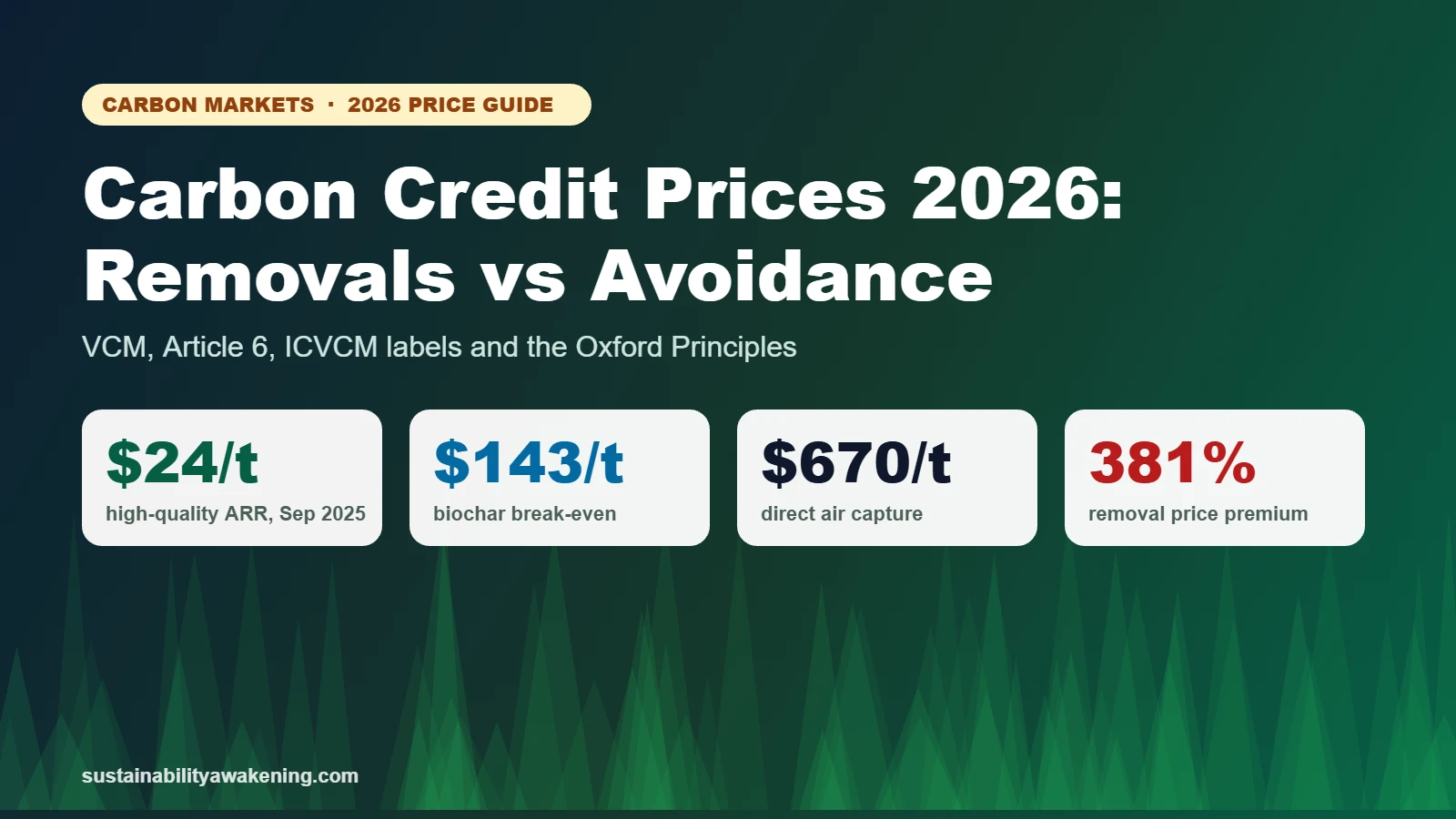
Carbon credits are being repriced around quality. In 2024 the volume of voluntary credits traded fell to its lowest level since 2018, yet prices barely moved and retirements held steady. Buyers are paying more for removals, recent vintages and credits with integrity labels. Meanwhile, the UN’s new Paris Agreement market issued its first credits in February 2026.
This guide explains what credits cost by type, what you are actually buying, how integrity labels and Article 6 work, and how to build a portfolio that will stand up to scrutiny. To price your own mix, use our free Carbon Credit Portfolio & Pricing Modeler. For the short version, see the carbon credit prices web story.
Carbon credits at a glance
The numbers that shape a 2026 credit budget.
- The carbon credit market in 2026
- Avoidance versus removal: what you are actually buying
- Carbon credit prices by type
- Integrity labels: ICVCM Core Carbon Principles
- Article 6: how the Paris Agreement markets work
- The Oxford Offsetting Principles in practice
- Building a credit portfolio: three worked examples
- How to buy: spot, forwards and offtakes
- Due diligence checklist before you buy
- How credits fit into net zero and disclosure
- Frequently asked questions
The carbon credit market in 2026
Ecosystem Marketplace’s 2025 State of the Voluntary Carbon Market report, covering 2024, describes a market in transition (Ecosystem Marketplace, May 2025). Transaction volumes fell 25% to the lowest level since 2018, but prices fell only 5.5%. Retirements, the best measure of real end-user demand, held at an elevated level, with 182 million tonnes retired from the ten largest standards.
Three shifts stand out in that data:
- Removals carry a big premium. Removal credits were on average 381% more expensive than reduction credits in 2024, up from 245% in 2023.
- Recent vintages win. Credits from the last five years traded at a 217% premium, compared with 53% a year earlier.
- Labels move prices. After landfill gas methodologies received ICVCM approval, their average price rose 35% between the first and second half of 2024.
The picture is of a legacy market based on older methodologies winding down, and a smaller, higher-quality market scaling up. For buyers, cheap credits are easy to find; credits that will survive a journalist, an auditor or a regulator are not.
Avoidance versus removal: what you are actually buying
Every credit represents one tonne of CO₂e, but tonnes are not equal. The most important distinction is between avoidance and removal.
| Avoidance / reduction | Nature-based removal | Durable removal | |
|---|---|---|---|
| Examples | REDD+ forest protection, clean cooking, landfill gas | Afforestation and reforestation (ARR), soil carbon | Biochar, enhanced rock weathering, BECCS, direct air capture |
| What it does | Prevents emissions that would otherwise happen | Pulls CO₂ from the air into trees and soils | Pulls CO₂ from the air into stable forms |
| Main risk | Baseline and additionality | Reversal by fire, pests or logging | Cost and measurement |
| Storage | None (nothing removed) | Decades, reversible | Centuries or longer |
| Role at net zero | Interim contribution | Interim, bridging | Neutralising residual emissions |
Adapted from the revised Oxford Offsetting Principles (2024).
Avoidance credits are not useless. Protecting standing forests keeps carbon out of the air and funds communities, and clean cooking cuts deadly household air pollution. But they cannot offset an emission permanently, because nothing has been removed. That is why serious net zero frameworks require a shift toward removals over time.
Carbon credit prices by type
Prices vary by type, project, vintage, rating and contract terms, so treat any single number as a range. These are the most useful public reference points for 2026 budgets:
| Credit type | Reference price | Source |
|---|---|---|
| REDD+ forest protection | Often single digits for legacy credits | Market data; varies widely |
| Clean cooking | Varies widely by methodology and label | Market data |
| Afforestation / reforestation (BBB+) | $24 (Sep 2025), up from $14 in Jan | Sylvera |
| Biochar | $143 supplier break-even; buyers see $94 as good value | CDR.fyi survey 2025 |
| Enhanced rock weathering | $272 break-even; $187 buyer good value | CDR.fyi survey 2025 |
| BECCS | $232 break-even; $301 reasonable profit | CDR.fyi survey 2025 |
| Direct air capture | $670 break-even; $822 reasonable profit | CDR.fyi survey 2025 |
Survey prices are averages of supplier and purchaser responses for 2025 delivery. Spot and contract prices differ.
The durable removal market is still small and dominated by a few buyers. CDR.fyi notes that only 32 purchasers have paid more than $500 per tonne, and that 98.5% of purchases above $1,000 per tonne came from Frontier buyers and the Milkywire Climate Transformation Fund. Its 2025 DAC snapshot warns that large-scale demand will not materialise at current costs, since demand is very limited above $500 per tonne (CDR.fyi).
Prices for nature-based removals are rising. Sylvera reports that some developers are quoting forward prices of $50 or more for future ARR vintages. You can test how these prices change your budget in our credit portfolio modeler.
Integrity labels: ICVCM Core Carbon Principles
The Integrity Council for the Voluntary Carbon Market (ICVCM) sets a global quality threshold called the Core Carbon Principles (CCPs). It assesses both crediting programmes and individual methodologies. Credits that pass both can carry a CCP label. Approved categories now include afforestation, biochar, biodigesters, efficient cookstoves, engineered carbon removal, improved forest management, landfill gas, leak detection and repair in gas systems, mangroves, mine methane, N₂O abatement, ozone-depleting substances, REDD+, rice methane and sustainable agriculture (ICVCM).
Treat the label as a floor, not a finish line. It tells you the methodology is sound; it does not guarantee that a specific project was well run. Pair it with project-level due diligence or an independent rating.
Article 6: how the Paris Agreement markets work
Article 6 of the Paris Agreement creates two routes for international carbon trading. Both use corresponding adjustments: when a country transfers a tonne abroad, it adds that tonne back to its own accounts so the reduction is not counted twice. Our Article 6 explainer covers the mechanics in depth.
- Article 6.2 lets countries agree bilateral deals and transfer “internationally transferred mitigation outcomes” (ITMOs) under their own rules.
- Article 6.4, the Paris Agreement Crediting Mechanism (PACM), is a UN-supervised crediting system that succeeds the Kyoto-era Clean Development Mechanism (CDM).
PACM reached a milestone on 26 February 2026, when its Supervisory Body approved the first-ever issuance of credits under the Paris Agreement (UNFCCC). The project distributes efficient cookstoves in Myanmar. Credits authorised for Korea can be used in the Korean Emissions Trading System, and the rest count toward Myanmar’s own climate target. Because PACM applies updated values and more conservative calculations, the credited reductions were about 40% lower than the project would have received under the CDM. More than 165 host-approved CDM projects are in the pipeline to transition.
For corporate buyers, Article 6 matters in two ways. Credits with a corresponding adjustment give a stronger claim, because the host country has not also counted the reduction. And compliance demand, from airlines under CORSIA and national schemes such as Korea’s, increasingly competes with voluntary buyers for the same high-quality supply.
Some countries also let companies use credits against carbon taxes. Singapore, for example, allows eligible international credits to offset up to 5% of taxable emissions; see our Singapore carbon tax guide.
The Oxford Offsetting Principles in practice
The Oxford Principles for Net Zero Aligned Carbon Offsetting, revised in 2024, are the most widely cited guide to using credits credibly (University of Oxford). They set four principles:
- Cut emissions, ensure the environmental integrity of credits used to achieve net zero, and regularly revise your offsetting strategy as best practice evolves.
- Transition to carbon removal offsetting for any residual emissions by the global net zero target date.
- Shift to removals with durable storage (low risk of reversal) to compensate any residual emissions by the net zero target date.
- Support the development of innovative and integrated approaches to achieving net zero, including early purchases that help new removal methods scale.
In practice this means a portfolio that changes over time: mostly high-quality avoidance and nature-based removals today, a rising share of durable removals each year, and only durable removals against residual emissions at net zero. Our modeler builds that glide path automatically from your current mix and net zero year.
Building a credit portfolio: three worked examples
Here is what 50,000 tonnes a year costs under three strategies, using the modeler’s default prices:
| Strategy | Mix | Average price | Annual cost | Removals | Durable |
|---|---|---|---|---|---|
| Lowest cost | 60% REDD+, 30% cookstoves, 10% ARR | $10/t | $480,000 | 10% | 0% |
| Balanced 2026 | 35% REDD+, 15% cookstoves, 30% ARR, 15% biochar, 5% ERW | $46/t | $2.31M | 50% | 20% |
| Oxford-aligned | 10% REDD+, 5% cookstoves, 35% ARR, 30% biochar, 10% ERW, 5% BECCS, 5% DAC | $125/t | $6.24M | 85% | 50% |
| Durable only | 55% biochar, 20% ERW, 10% BECCS, 15% DAC | $257/t | $12.84M | 100% | 100% |
Illustrative. Avoidance prices are assumptions; removal prices from Sylvera (ARR) and CDR.fyi (durable). Real quotes will differ.
The gap is large: an Oxford-aligned portfolio costs roughly 13 times the cheapest option today. That is why the first Oxford principle comes first. Every tonne you cut in your own operations and value chain is a tonne you never have to buy at durable removal prices. Cut emissions with tools such as our GHG Emissions Engine and Scope 3 guide before sizing a credit budget.
How to buy: spot, forwards and offtakes
How you buy matters almost as much as what you buy. There are three main routes, and most mature buyers use a mix.
- Spot purchases of issued credits from brokers, exchanges or developers. They are fast and let you see exactly what you are getting, but the best recent-vintage, high-rated supply is scarce and prices move quickly.
- Forward contracts for credits a project will issue in future years, usually at a fixed price. They help projects get financed and can lock in today’s prices for removals, but carry delivery risk if the project under-performs.
- Offtake agreements for durable removals, often multi-year and pre-paid in part. Coalitions such as Frontier use them to give new removal methods the revenue certainty they need to build their first large plants.
A practical approach for a mid-sized buyer is to cover this year’s needs with labelled, recent-vintage spot credits, sign forwards for nature-based removals over the next three to five years, and commit a small, rising share of the budget to durable removal offtakes. That mirrors the Oxford glide path and spreads price and delivery risk.
Whichever route you use, insist on retirement in your name on a public registry, with serial numbers you can cite in your sustainability report. Unretired credits held in an account are not a claim.
Due diligence checklist before you buy
- Additionality: would the project have happened anyway without credit revenue?
- Baseline: is the counterfactual conservative, and is it updated? PACM’s first issuance cut credited volumes by about 40% versus the old CDM approach.
- Permanence: what is the reversal risk, how long is carbon stored and is there a buffer pool?
- Leakage: does protecting one area simply push deforestation elsewhere?
- Measurement, reporting and verification: who verifies, how often, with what data?
- Label and rating: is the methodology CCP-approved, and what do independent ratings say?
- Corresponding adjustment: has the host country authorised the credit and adjusted its accounts?
- Vintage: recent vintages are more credible and, per Ecosystem Marketplace, command a large premium.
- Co-benefits and safeguards: community consent, benefit-sharing and grievance mechanisms.
- Claims: match your public wording to what the credit can support, and avoid “carbon neutral” product claims that regulators increasingly challenge.
How credits fit into net zero and disclosure
Credits sit outside your emissions inventory. Under the GHG Protocol, Scope 1, 2 and 3 emissions are reported gross, and any credits are disclosed separately. Science-based near-term targets must be met by cutting emissions, not by buying credits; credits can support beyond-value-chain mitigation, and permanent removals are expected to neutralise residual emissions at net zero. See our SBTi net zero guide and SBTi pathway modeler.
Disclosure rules increasingly ask how you use credits. ISSB-based standards require companies to disclose planned use of carbon credits to meet targets, including whether they are removals or reductions. The same logic applies to building owners: New York’s Local Law 97 lets offsets cover only up to 10% of a building’s emissions limit (see our Local Law 97 guide).
Frequently asked questions
How much does a carbon credit cost in 2026?
It depends on the type. Avoidance credits such as forest protection (REDD+) often trade in single digits per tonne. High-quality afforestation credits averaged about $24 per tonne in September 2025 according to Sylvera. Durable removals cost far more: suppliers in CDR.fyi’s 2025 survey reported break-even prices of about $143 per tonne for biochar, $272 for enhanced rock weathering and $670 for direct air capture.
What is the difference between carbon avoidance and carbon removal credits?
Avoidance or reduction credits pay for emissions that would otherwise have happened, for example by protecting a forest or replacing a polluting stove. They remove nothing from the atmosphere. Removal credits pay for CO2 that is taken out of the air and stored, in trees and soils or more durably in rock, biochar or geological storage.
What is an Article 6 carbon credit?
Article 6 of the Paris Agreement lets countries trade emission reductions. Under Article 6.2, countries agree bilateral deals and transfer ‘internationally transferred mitigation outcomes’ with corresponding adjustments so the same tonne is not counted twice. Under Article 6.4, the UN-run Paris Agreement Crediting Mechanism issues credits; it approved its first issuance, for a clean cooking project in Myanmar, on 26 February 2026.
What are the Oxford Offsetting Principles?
They are guidelines from the University of Oxford, revised in 2024, for net zero aligned offsetting. In short: cut your own emissions and use high-integrity credits; shift to carbon removals for residual emissions by your net zero date; shift to removals with durable storage; and support the development of innovative approaches.
Can carbon credits count toward a science-based target?
Not toward near-term SBTi reduction targets, which must be met by cutting emissions in your own operations and value chain. Credits can support beyond-value-chain mitigation, and permanent removals are expected to neutralise residual emissions at net zero.
What does a CCP label mean on a carbon credit?
It means the credit comes from a crediting programme and a methodology that the Integrity Council for the Voluntary Carbon Market (ICVCM) has assessed against its Core Carbon Principles. Approved categories include afforestation, biochar, engineered removals, REDD+, efficient cookstoves and landfill gas, among others. The label is a quality floor, not a guarantee for every project.
Sources
- Ecosystem Marketplace, State of the Voluntary Carbon Market 2025 (29 May 2025)
- UNFCCC, UN carbon market approves first-ever issuance of credits under the Paris Agreement (26 Feb 2026)
- UNFCCC, Paris Agreement Crediting Mechanism
- CDR.fyi, Durable CDR Market Pricing Survey (Jan 2025)
- CDR.fyi, Direct Air Capture Market Snapshot 2025
- Sylvera, Q3 2025 Carbon Data Snapshot
- University of Oxford, Oxford Principles for Net Zero Aligned Carbon Offsetting (revised 2024)
- ICVCM, CCP-approved methodologies
This guide is for general information and is not investment, legal or procurement advice. Check project documentation and current rules before buying credits.
EU CBAM Duty & Tariff Calculator
Model European Carbon Border Adjustment Mechanism liability, embedded specific emissions, and weekly EU ETS certificate pricing for regulated goods.
Model CBAM Duty →