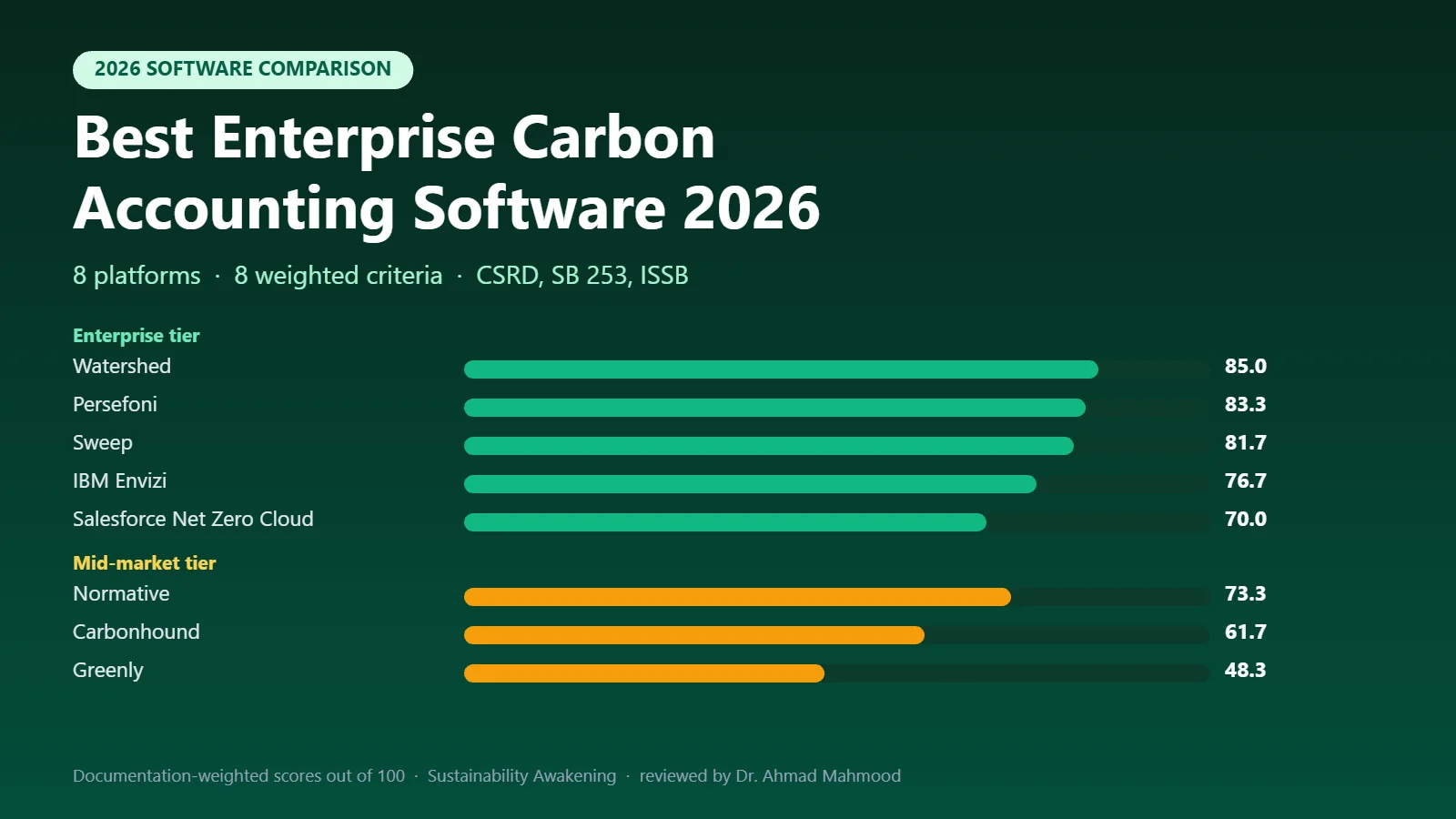
Choosing carbon accounting software is now an audit decision, not a dashboard decision. In 2026 the platforms that matter are the ones whose numbers survive a limited-assurance review under the EU Corporate Sustainability Reporting Directive (CSRD) or a filing under California’s SB 253. This guide compares eight platforms on eight weighted criteria, in two tiers: five enterprise suites for complex multinational groups, and three mid-market tools for companies that need a credible inventory without an enterprise budget.
Every score is based on what each vendor documents on its own public website, checked in October 2026, so you can verify every claim yourself. Before you book demos, estimate your inventory with our free GHG Emissions Engine and map material topics with the CSRD Double Materiality Checker.
No paid placements, no affiliate links. As of 25 October 2026, Sustainability Awakening has no affiliate, referral, sponsorship or other paid relationship with any vendor on this page, and no vendor saw this ranking before publication. If that ever changes, we will label the affected links clearly, in line with US Federal Trade Commission endorsement guidance and Google’s guidance on reviews. Scores are based only on each vendor’s own public documentation; we did not run paid trials.
Vendors: if any fact here is wrong or out of date, email contact@sustainabilityawakening.com with a public source and we will review it within 10 working days and log the change at the foot of this page.
- The 2026 shortlist at a glance
- What changed in 2026: CSRD, SB 253 and the SEC
- How we scored: 8 weighted criteria
- Enterprise tier matrix
- ESRS E1, supplier engagement and assurance
- Enterprise vendor profiles
- Mid-market tier matrix and profiles
- How to choose: a 7-step buying process
- FAQs
The 2026 shortlist at a glance
| Platform | Tier | Score / 100 | Best fit |
|---|---|---|---|
| Watershed | Enterprise | 85.0 | Assurance-led CSRD programmes and large supplier bases |
| Persefoni | Enterprise | 83.3 | Finance-grade ledger, financed emissions (PCAF) and a free entry tier |
| Sweep | Enterprise | 81.7 | Multi-entity groups with heavy Scope 3 and CSRD workload |
| IBM Envizi | Enterprise | 76.7 | Data-heavy estates (sites, meters, ERP) and IBM or SAP shops |
| Salesforce Net Zero Cloud | Enterprise | 70.0 | Companies already standardised on Salesforce |
| Normative | Mid-market | 73.3 | Fast, factor-rich baselines with included GHG Protocol advisers |
| Carbonhound | Mid-market | 61.7 | North American SMEs that want a published price and quick setup |
| Greenly | Mid-market | 48.3 | Growing companies needing CSRD, CDP and supplier modules in one place |
Enterprise and mid-market scores use different weights (see methodology), so compare within a tier, not across tiers.
What changed in 2026: CSRD, SB 253 and the SEC
Three regulatory shifts changed what “compliance-ready” means for carbon software this year.
- CSRD narrowed, ESRS simplified. The Omnibus I directive, which the Council signed off in February 2026 (Council of the EU), limits the CSRD to companies with more than 1,000 employees and over €450 million of net turnover. On 3 July 2026 the European Commission finalised delegated acts revising the ESRS and creating a voluntary standard for smaller companies (Deloitte summary). Software must now track the revised ESRS datapoints, not the 2023 set.
- California SB 253 is the live US deadline. The California Air Resources Board (CARB) set 10 November 2026 as the first deadline for Scope 1 and Scope 2 reports, with Scope 3 from 2027 and assurance phasing in (CARB programme page). Our SB 253 and SB 261 guide covers who is in scope.
- The SEC climate rule is effectively dead. Adopted in March 2024 and stayed a month later, it never took effect, and in May 2026 the SEC proposed to rescind it (SEC newsroom). We therefore score “regulatory export” on CSRD/ESRS, ISSB and SB 253 output rather than SEC formats.
The common thread is assurance. CSRD requires limited assurance of the sustainability statement, and SB 253 phases in assurance of Scope 1 and 2 data. That is why audit trail and assurance readiness is the heaviest criterion in our enterprise weighting.
How we scored: 8 weighted criteria
Each platform received 0 to 3 points per criterion, based only on evidence in the vendor’s own public documentation in October 2026: 3 means the capability is documented in detail; 2 means it is documented but limited, an add-on or tier-dependent; 1 means it is only mentioned or we could not find public detail; 0 means not documented at all (for pricing, “contact sales” only). Points are multiplied by the criterion weight and scaled to 100.
| Criterion | What earns 3 points | Enterprise weight | Mid-market weight |
|---|---|---|---|
| Scope 1, 2 and 3 data ingestion | Automated ingestion from ERP, utilities and files across all 15 Scope 3 categories | 15% | 15% |
| Emission-factor library and freshness | Large, regularly updated, region-specific factor library with custom factors | 10% | 10% |
| Audit trail and limited-assurance readiness | Per-metric data lineage, review workflows, assurance-ready exports, security certifications | 20% | 10% |
| Regulatory export (CSRD/ESRS, ISSB, SB 253) | Documented CSRD/ESRS, ISSB and SB 253 outputs | 15% | 10% |
| Scope 3 supplier engagement | Supplier requests, supplier-specific data and prioritisation at scale | 15% | 10% |
| API and integration flexibility | Public APIs or a broad, documented connector library | 10% | 5% |
| Published implementation speed | A published, specific implementation timeline or onboarding package | 10% | 20% |
| Pricing transparency | Full public price list | 5% | 20% |
Mid-market buyers usually have smaller teams and fixed budgets, so implementation speed and price transparency carry more weight in that tier.
This is a documentation review, not a hands-on test. A low score can mean a vendor simply does not publish the detail; ask for it in your request for proposal. A high score means the claim is public and testable in a demo.
Enterprise tier: the weighted matrix
| Criterion (weight) | Watershed | Persefoni | Sweep | IBM Envizi | Salesforce Net Zero Cloud |
|---|---|---|---|---|---|
| Scope 1, 2 and 3 data ingestion (15%) | 3/3 | 3/3 | 3/3 | 3/3 | 2/3 |
| Emission-factor library and freshness (10%) | 3/3 | 2/3 | 2/3 | 2/3 | 2/3 |
| Audit trail and limited-assurance readiness (20%) | 3/3 | 3/3 | 3/3 | 3/3 | 3/3 |
| Regulatory export (CSRD/ESRS, ISSB, SB 253) (15%) | 3/3 | 3/3 | 3/3 | 2/3 | 2/3 |
| Scope 3 supplier engagement (15%) | 3/3 | 2/3 | 3/3 | 2/3 | 2/3 |
| API and integration flexibility (10%) | 2/3 | 3/3 | 2/3 | 3/3 | 3/3 |
| Published implementation speed (10%) | 1/3 | 1/3 | 1/3 | 1/3 | 1/3 |
| Pricing transparency (5%) | 0/3 | 2/3 | 0/3 | 1/3 | 0/3 |
| Weighted score / 100 | 85.0 | 83.3 | 81.7 | 76.7 | 70.0 |
Evidence: vendor product, CSRD, supply chain and pricing pages listed in Sources, checked 24–25 October 2026.
Watershed, Persefoni and Sweep are separated by only a few points, and all three document strong assurance and regulatory output. IBM Envizi and Salesforce Net Zero Cloud lose ground mainly on regulatory export detail and published pricing, but score full marks on APIs, which matters if sustainability data must flow into finance and planning systems. None of the five enterprise vendors publishes an implementation timeline.
ESRS E1, Scope 3 supplier engagement and assurance compared
For CSRD filers, three capabilities decide whether a platform reduces audit pain or adds to it. The table summarises what each enterprise vendor documents publicly.
| Platform | CSRD / ESRS E1 | Scope 3 supplier engagement | Audit and assurance |
|---|---|---|---|
| Watershed | Materiality mapped to ESRS; ESRS metrics auto-calculated; data maps to CDP, TCFD and ISSB | Supply Chain product ranks suppliers by emissions and maturity; replaces estimates with supplier-specific data | Full data lineage per metric, 150+ automated checks, one-click exports for limited-assurance review; partnerships with EY, KPMG and Deloitte |
| Persefoni | CSRD, ISSB and California (CA-CCDAA) GHG metrics reports | Send and respond to supplier data requests; Scope 3 categories 1–15 | Footprint ledger and audit trail tracking; SOC 2 and ISO 27001 |
| Sweep | Double materiality matrix exportable to PNG or Excel; ESRS-aligned disclosures; also SB 253, ISSB, UK SRS and CDP | AI-assisted supplier data collection; scales to thousands of suppliers | Centralised, audit-ready data and an audit and assurance workflow |
| IBM Envizi | Emissions engine built on the GHG Protocol; disclosure reporting | Supplier engagement for Scope 3 categories 1 and 2 | Data health checks and audit trails; ingestion from ERP, IoT, meters and supplier portals |
| Salesforce Net Zero Cloud | Disclosure and Compliance Hub; materiality assessment; AI-assisted disclosure authoring | Scope 3 Hub matches spend to factors for category 1 and other spend-based categories | Agentforce actions with audit trails; Data 360 as a single auditable record |
Summarised from each vendor’s public pages, October 2026. “ESRS E1” is the climate change standard, which includes gross Scope 1, 2 and 3 emissions.
Enterprise vendor profiles
Watershed — 85.0/100
Watershed positions itself as an assurance-first platform. Its CSRD page documents per-metric data lineage, more than 150 automated checks and structured exports for limited-assurance review, and its carbon accounting page lists 60+ pre-built integrations. Watershed also maintains CEDA, a widely used open environmentally extended input–output (EEIO) database, which explains its top factor score. Pricing is quote-only.
Persefoni — 83.3/100
Persefoni is the only enterprise vendor with a free tier: Pro covers Scope 1, 2 and 3 for simpler companies, while Advanced adds custom calculation frequency, proprietary and custom emission factors, an APIs and Integration Hub and PCAF financed-emissions coverage. Its pricing page lists CSRD, ISSB and California GHG metrics reports, an audit trail and SOC 2 and ISO 27001 compliance. A strong choice for banks, asset managers and finance-led teams.
Sweep — 81.7/100
Sweep targets multi-entity groups. Its CSRD page covers double materiality and ESRS-aligned disclosures, and its platform page describes AI-assisted data mapping, supplier engagement that scales to thousands of suppliers and audit-ready data. Sweep says it was named a Leader in the Verdantix 2026 Green Quadrant for enterprise carbon management. Pricing is quote-only.
IBM Envizi — 76.7/100
Envizi is strongest where the problem is data volume: thousands of sites, meters and invoices. IBM documents ingestion from ERP systems, IoT and metering platforms, utility providers and supplier portals, plus data health checks, audit trails and a separate Emissions API. Its pricing page explains that price is based on data volume and offers an online estimate, which earned a partial pricing score.
Salesforce Net Zero Cloud — 70.0/100
Net Zero Cloud runs on the Salesforce platform, so it inherits Salesforce’s APIs, Data 360 and Agentforce automation. The pricing page now lists a single Growth edition at “contact us for pricing”, with Scope 3 Hub for spend-based categories, a Disclosure and Compliance Hub and materiality assessment. It is the natural fit when sales, procurement and service data already live in Salesforce.
Mid-market tier: matrix and profiles
Mid-market buyers typically need a defensible GHG Protocol inventory for customers, lenders and supply-chain requests such as CDP or EcoVadis, sometimes with CSRD or SB 253 exposure through a large customer. These three platforms are built for that job.
| Criterion (weight) | Normative | Carbonhound | Greenly |
|---|---|---|---|
| Scope 1, 2 and 3 data ingestion (15%) | 3/3 | 2/3 | 2/3 |
| Emission-factor library and freshness (10%) | 3/3 | 1/3 | 2/3 |
| Audit trail and limited-assurance readiness (10%) | 2/3 | 1/3 | 1/3 |
| Regulatory export (CSRD/ESRS, ISSB, SB 253) (10%) | 2/3 | 2/3 | 2/3 |
| Scope 3 supplier engagement (10%) | 2/3 | 1/3 | 2/3 |
| API and integration flexibility (5%) | 1/3 | 1/3 | 1/3 |
| Published implementation speed (20%) | 3/3 | 2/3 | 1/3 |
| Pricing transparency (20%) | 1/3 | 3/3 | 1/3 |
| Weighted score / 100 | 73.3 | 61.7 | 48.3 |
Mid-market weights give implementation speed and pricing transparency 20% each. Evidence checked 24–25 October 2026.
Normative — 73.3/100
Normative’s pricing page is unusually specific about method: more than 349,000 emission factors covering over 200 countries, AI-powered data matching, a full baseline including Scope 3 in 8 to 12 weeks, a reporting suite for SECR and CSRD, and access to more than 20 GHG Protocol-certified advisers. Prices are quote-based across Essential and Premium packages.
Carbonhound — 61.7/100
Carbonhound is the price-transparency leader. Its pricing page lists platform fees from $600 a year (1–19 employees) to $5,700 a year (250–499 employees), a $1,750 onboarding package and automated data feeds from $60 per source per year, with a 30% discount for non-profits. Its website lists CDP, OSFI and SEC-aligned exports and SB 253, SBTi and CBAM support, but publishes little detail on audit trails.
Greenly — 48.3/100
Greenly bundles carbon assessment, supplier engagement, an emission-factor product and regulatory modules, including a CSRD reporting product with double materiality, California laws, CBAM and EcoVadis support. The pricing page sets out plan contents and add-ons, such as custom API integration and SSO, but not prices.
If your company is approaching the CSRD thresholds, or a key customer is asking for assured Scope 3 data, test the enterprise tier too: switching platforms mid-assurance cycle is expensive.
How to choose: a 7-step buying process
Know your numbers before the vendor demo
Sales demos go better when you already know your rough inventory and which ESRS topics are material. Both of these take under 15 minutes.
- Baseline first. Run a rough Scope 1, 2 and 3 estimate in the GHG Emissions Engine so you know which categories dominate.
- Fix the reporting perimeter. Decide whether you report under CSRD, SB 253, ISSB-based rules or voluntary frameworks, and map material topics with the Double Materiality Checker.
- Weight the criteria yourself. Copy our eight criteria and adjust the weights; an assurance-bound group and a supplier answering CDP requests need different tools.
- Ask for evidence, not features. Request a sample audit trail for one metric, the factor library version and update cadence, and a reference customer that passed limited assurance.
- Test with your own data. Load one entity’s real ERP extract and utility bills during the trial and time how long it takes.
- Price the whole programme. Include implementation, supplier engagement, extra entities and assurance support, not just the licence.
- Plan the exit. Confirm you can export raw activity data, factors and calculations in an open format if you change vendor later.
For target-setting after the inventory, see our SBTi Corporate Net-Zero Standard guide; importers into the EU should also check embedded emissions with the CBAM calculator. More tools are on our resources page.
Frequently asked questions
What is the best enterprise carbon accounting software in 2026?
On our documentation-weighted scoring, Watershed (85.0/100), Persefoni (83.3) and Sweep (81.7) lead the enterprise tier, because each documents strong audit trails, CSRD and ISSB outputs and Scope 3 supplier tools on its own public pages. The best choice still depends on your stack: companies standardised on Salesforce or IBM often get faster adoption from Net Zero Cloud or Envizi, which also scored well on APIs and audit trails.
Which carbon accounting software is best for CSRD and ESRS E1?
Look for three things: a double materiality workflow mapped to ESRS topics, automatic calculation of ESRS E1 climate metrics such as gross Scope 1, 2 and 3 emissions, and structured exports your assurance provider can test. Watershed and Sweep document all three on their CSRD pages, Persefoni offers a CSRD GHG metrics report, and Greenly has a CSRD reporting product with a double materiality module. Remember that after the Omnibus I directive, CSRD applies only to companies with more than 1,000 employees and over 450 million euros of net turnover.
Do I still need SEC climate disclosure features in 2026?
Probably not for SEC filings. The SEC’s March 2024 climate rule was stayed in April 2024, never took effect, and in May 2026 the SEC proposed to rescind it. What US companies need now is California SB 253 support: CARB moved the first Scope 1 and Scope 2 reporting deadline to 10 November 2026, with Scope 3 reporting starting in 2027. We therefore scored regulatory export on CSRD/ESRS, ISSB and SB 253 output rather than the SEC rule.
How much does enterprise carbon accounting software cost?
Most enterprise platforms do not publish prices and quote after a scoping call. Among the eight we reviewed, Carbonhound publishes a full price list from 600 US dollars a year for companies with 1 to 19 employees to 5,700 US dollars for 250 to 499 employees, plus an optional 1,750 dollar onboarding package. Persefoni offers a free Pro tier, and IBM provides an online estimator that prices Envizi by data volume. Expect enterprise contracts to be significantly higher than mid-market list prices once Scope 3 and assurance support are included.
How long does it take to implement carbon accounting software?
Only one vendor in our review publishes a timeline: Normative states a full carbon baseline, including Scope 3, in 8 to 12 weeks. In practice, timelines depend mostly on your data, not the software. Companies with clean ERP spend data, utility bills and fleet fuel records can baseline in one quarter, while those collecting supplier-specific Scope 3 data or preparing for limited assurance should plan for two to three reporting cycles.
Sources
- Watershed, CSRD reporting and assurance (accessed 25 Oct 2026)
- Watershed, Supply Chain
- Watershed, carbon accounting and integrations
- Persefoni, pricing and plan capabilities
- Sweep, CSRD
- Sweep, platform
- IBM Envizi ESG Suite
- IBM Envizi pricing
- Salesforce Net Zero Cloud pricing
- Salesforce Net Zero Cloud
- Normative, packages and pricing
- Greenly, pricing
- Greenly, CSRD reporting
- Carbonhound, pricing
- Council of the EU, sign-off of sustainability reporting simplification (24 Feb 2026)
- Deloitte, Omnibus developments and revised ESRS (17 Jul 2026)
- California Air Resources Board, Corporate Disclosure of Climate Data
- US SEC, SEC proposes rescission of climate-related disclosure rules (press release 2026-49)
- GHG Protocol Corporate Standard
Corrections log: first published 25 October 2026. Vendors and readers can send corrections with a public source to contact@sustainabilityawakening.com. This comparison is for information only and is not legal, procurement or investment advice.
Water Footprint Impact Calculator
Measure direct and virtual water consumption across household, agricultural, and industrial supply chains against regional watershed stress metrics.
Calculate Water Footprint →