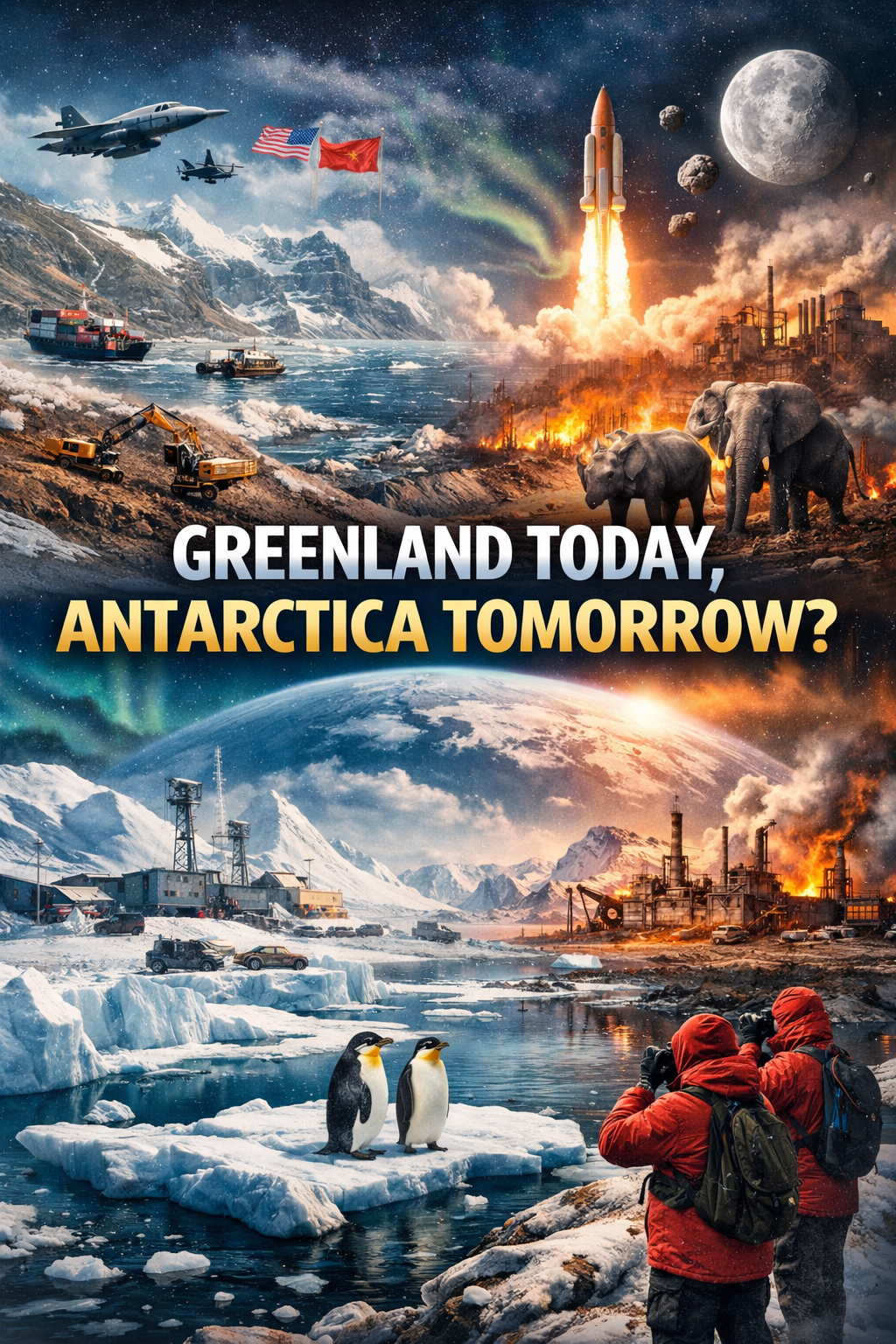
The map of the world is being redrawn, but not by cartographers. It is being redrawn by heat, greed, and a sudden, sharp amnesia regarding the “Global Commons.”
As we sit in the early weeks of 2026, the diplomatic “hue and cry” over Greenland has reached a fever pitch. What was once dismissed as a fringe geopolitical curiosity—the “buying” of the world’s largest island—has transformed into a clinical, bilateral scramble for rare earth elements and strategic ice. But for those of us in the Global South, this isn’t just about the North Atlantic. It is a terrifying blueprint for a new era of colonial ecology.
The Icelandic Warning: A Fragile Balance
To understand the danger, we must look at our recent history. Do you remember the relentless volcanic eruptions in Iceland’s Reykjanes Peninsula throughout 2024 and 2025? We watched as fissures tore through the earth, but the true alarm wasn’t just the lava—it was the record-breaking May 2025 heatwave that followed.
In a region where the ecosystem is balanced on a knife-edge of temperature, the combination of geothermal upheaval and human-induced warming created an ecological “double-tap.” When temperatures in Iceland and Eastern Greenland spiked 13°C above average last year, it wasn’t just a weather event; it was a demonstration of how quickly “permanent” landscapes can destabilize.
If a single volcanic chain can disrupt the climate of a region so thoroughly, what happens when we introduce industrial-scale mining, shipping lanes, and military outposts?
The “Scramble” Logic: From Ice to Space
The logic being applied to Greenland today—that resource scarcity justifies the occupation of sensitive zones—is a virus. If the international community accepts that Greenland is “up for grabs” because its ice is melting, what stops the same logic from being applied to Antarctica tomorrow?
We are already seeing the “cracks” in the Antarctic Treaty. In the last year, “scientific” bases have proliferated along the Antarctic Peninsula, often serving as thinly veiled placeholders for future territorial claims. The 2048 moratorium on Antarctic mining feels less like a shield and more like a countdown.
This culture of “occupy and exploit” doesn’t stop at our poles. If we normalize the desecration of the Earth’s most sensitive “refrigerators” for material gain, the Moon is next. We are teaching the next generation that there is no such thing as a “protected region”—only a region that hasn’t been priced yet.
The Great Hypocrisy: A View from the South
As the Global South authority, we must call out the staggering double standard at play.
- We are told to stop Brazil from managing the Amazon because it is the “lungs of the planet.”
- We are told the Peat-lands of Africa and Southeast Asia must remain untouched as “carbon bombs.”
- We are sanctioned and lectured on rhino and elephant poaching to preserve the world’s “natural heritage.”
Yet, the same voices demanding conservation in the South are the ones currently bidding on the minerals beneath the Greenlandic ice sheet. Why is a forest in the Congo a “global heritage,” but the Arctic is a “national resource”?
If the North continues this trend, we are witnessing the total decentralization of Multilateral Environmental Agreements (MEAs). We are moving back to a world where “The Environment” is no longer a shared trans-boundary responsibility, but a national asset to be traded or destroyed for profit.
What Are We Giving Our Children?
The planet Earth exists in its current state because our elders—flawed as they were—understood the value of collaboration over standing against each other. They built the Paris Agreement and the Antarctic Treaty not out of saintliness, but out of the cold realization that trans-boundary problems require trans-boundary solutions.
Today’s materialistic rush ignores this wisdom. We are trading the very climate stability that allows our children to breathe for a few decades of battery minerals and “strategic positioning.”
If we don’t stop the scramble for Greenland now, we aren’t just losing an island. We are losing the idea that anything on this planet belongs to the future.
Is the “Rules-Based Order” only for the South? Let’s discuss in the comments.
This post is part of our series on the “New Colonialism” of the 2020s. Subscribe to stay informed on the Global South’s perspective on the world’s most pressing frontiers.
Authoritative Source: NOAA Climate Data
The New Geography of Mineral Desire
For centuries, the frozen poles existed at the outermost edges of human ambition — places where explorers perished and empires could not reach. Today, climate change is redrawing that map. As Arctic and Antarctic ice retreats, it reveals what geological surveys have long suspected: mineral deposits of staggering value. Rare earth elements, uranium, oil, natural gas, lithium, zinc, gold — the substances that power modern civilization are locked beneath millennia of ice, and the warming planet is opening the vault.
Greenland sits at the epicenter of this scramble. The world’s largest island, 80 percent ice-covered, holds an estimated 17 significant rare earth deposits alongside uranium, lithium, and some of the highest-grade iron ore on the planet. As the Greenlandic ice sheet retreats — losing approximately 280 billion tons of ice per year, according to NASA — more geology becomes accessible, and more commercial interest accumulates. The geopolitical and ecological stakes of this environmental transformation are enormous and intimately linked.
Greenland: A Colony No Longer, But Still Contested
Greenland achieved home rule from Denmark in 1979 and self-governance in 2009, retaining Danish authority only over defense and foreign policy. Its government, the Naalakkersuisut, has jurisdiction over its own resources — a point of enormous practical significance given the mineral wealth now attracting global attention.
The 2021 Greenlandic election was fought substantially over mining policy, after the previous government granted a mining license to the Kvanefjeld project — a massive rare earth and uranium deposit. The Inuit Ataqatigiit (IA) party won on an anti-uranium platform, and subsequently revoked the Kvanefjeld license, triggering an international arbitration claim. The episode illustrates the collision between global demand for critical minerals and Indigenous sovereign rights over ancestral territory.
International actors have been watching closely. China, the dominant global supplier of rare earth elements, has invested significantly in Greenland resource exploration. The United States, alarmed by Chinese mineral supply chain dominance, has made Greenlandic resources a strategic priority. Geopolitical competition over Greenland’s resources is intensifying precisely as the climate crisis makes those resources more accessible.
The Antarctic Constraint: A Treaty Under Pressure
Antarctica presents a different but related story. The Protocol on Environmental Protection to the Antarctic Treaty, adopted in 1991, explicitly prohibits any activity relating to mineral resources other than scientific research. This prohibition — the Madrid Protocol — applies for at least 50 years from 1998, meaning no formal review can occur before 2048.
The Madrid Protocol appears robust on paper, but its durability is increasingly questioned. Climate change is exposing the continent’s geology even as geopolitical tensions among major powers escalate. China has dramatically expanded its Antarctic presence, establishing five research stations, including Qinling Station (opened 2024), and conducting extensive geological surveys under the banner of scientific research. The Antarctic Treaty System was designed for a different world — its adequacy for the coming decades is an open question.
The Rare Earth Bottleneck and Why It Drives Polar Ambition
The 17 rare earth elements — including neodymium, dysprosium, and praseodymium — are critical components of electric vehicle motors, wind turbine generators, semiconductor manufacturing, and military guidance systems. The clean energy transition depends on them. China currently produces approximately 60 percent of global rare earth supply and controls around 85 percent of global processing capacity — a dominance built over decades of deliberate industrial policy.
Western efforts to diversify rare earth supply chains have produced limited results: the Mountain Pass mine in California, the only significant U.S. rare earth producer, ships most of its ore to China for processing due to the absence of domestic processing infrastructure. The IEA projects that demand for rare earth elements will grow 3-7x by 2040 under clean energy transition scenarios, dramatically intensifying supply pressure on polar resources.
Indigenous Rights and the Consent Imperative
Perhaps the most significant constraint on polar mineral development is the growing international legal recognition of Indigenous Free, Prior, and Informed Consent (FPIC) as a standard for resource development on traditional lands. The UN Declaration on the Rights of Indigenous Peoples, adopted in 2007, establishes FPIC as a right, not merely a procedural courtesy.
The intersection of climate justice and resource justice is particularly pointed in the Arctic. Inuit and other Arctic Indigenous peoples are among the most severely affected by climate change — their traditional livelihoods are directly disrupted — yet they risk bearing the additional burden of industrial extraction driven by a global economy’s demand for the minerals needed to decarbonize. The bitter irony: the clean energy transition that may eventually stabilize global temperatures requires mining that threatens the territories of those already most damaged by warming.
What Comes Next: Scenarios for the Polar Resource Future
Multiple futures are possible. In one scenario, multilateral frameworks hold: the Antarctic Treaty’s mineral prohibition survives to 2048 and beyond, Greenlandic Inuit exercise meaningful sovereignty over resource decisions, and circular economy advances reduce demand for virgin rare earth extraction. In another scenario, geopolitical competition fractures multilateral institutions, the Madrid Protocol faces renegotiation under pressure, and political fragility enables extraction agreements that underserve Indigenous interests.
Technology represents a wildcard. Advances in deep-sea nodule mining could provide a non-polar alternative for some critical mineral supplies. Improved recycling and materials substitution could reduce rare earth demand significantly. Urban mining — recovering critical materials from electronic waste — remains vastly underscaled relative to its theoretical potential but is growing rapidly. What is clear is that the polar regions will remain at the center of global resource, climate, and geopolitical dynamics for the foreseeable future. The ice is retreating, the deposits are there, and the demand is growing. The question is whether international governance, Indigenous rights, and ecological ethics can keep pace with the race to claim what the melting reveals.
For those watching from outside the Arctic — consumers of electronics, electric vehicles, and renewable energy systems — the connection to daily choices is real. Sustainable consumption choices and advocacy for circular economy policies represent meaningful levers that people far from the ice sheet can actually pull.
EU CBAM Duty & Tariff Calculator
Model European Carbon Border Adjustment Mechanism liability, embedded specific emissions, and weekly EU ETS certificate pricing for regulated goods.
Model CBAM Duty →