The global imperative to mitigate atmospheric carbon has necessitated innovative financial and ecological mechanisms. At the forefront of this systemic transition is the LINC Cornwall carbon offsetting tool. By localizing environmental finance, this platform connects corporate sustainability goals directly with regional land management. It operates as a critical node in a much larger ecological network.
Understanding the mechanics of the LINC Cornwall carbon offsetting tool requires analyzing both market dynamics and earth systems. Traditional carbon offsets often suffer from opacity and spatial disconnect. By contrast, a regionally grounded model ensures that financial investments yield verifiable, immediate ecological improvements within a specific geographical catchment. This localized approach prevents the abstraction of environmental harm.
We must connect these local interventions to broader systemic climate patterns. When a local marsh is restored through this financial exchange, it does more than balance a corporate ledger. It alters the local hydrological cycle, sequesters atmospheric carbon into the soil biosphere, and stabilizes microclimates. This regional resilience acts as a buffer against the macro-level volatility of global climate change.
Table of Contents
How LINC Cornwall Compares to Other Regional Carbon Offsetting Tools
The carbon offsetting landscape has proliferated dramatically over the past decade, with dozens of regional, national, and international tools competing for the attention of landowners, local authorities, and businesses seeking credible offset solutions. LINC Cornwall stands apart from many competitors through its geographic specificity and ecological grounding, but understanding where it fits in the broader landscape helps users make more informed decisions about its appropriateness for their particular needs.
National-level schemes like the UK Woodland Carbon Code and the Peatland Code offer standardized methodologies verified by independent auditors and recognized by the UK government as credible offset mechanisms. These schemes carry significant credibility advantages: their units can be traded on voluntary carbon markets, they have established verification tracks, and buyers can demonstrate compliance with recognized standards. However, their geographic scope means they may not capture the specific ecological context of Cornish landscapes, which have distinctive characteristics including Atlantic-influenced climate, unique geology, and particular assemblages of habitats that affect carbon sequestration rates.
The Soil Association Organic Trust and similar sector-specific schemes offer another category of comparison. These tools focus on agricultural systems and organic matter accumulation in soils, aligning well with farming operations but offering less comprehensive coverage of woodland and peatland habitats that LINC Cornwall addresses. Regional biodiversity net gain schemes emerging from the Environment Act 2021 implementation create another point of comparison, as they require quantification of ecological value changes that partially overlaps with carbon accounting.
International voluntary carbon market tools like Verra and Gold Standard offer access to a global marketplace but typically require significant transaction costs and technical capacity that may be prohibitive for smaller Cornish landowners. LINC Cornwall’s regional focus reduces these barriers while maintaining ecological credibility through its grounding in peer-reviewed science. For landowners seeking to participate in local carbon markets or attract buyers who prioritize regional ecological specificity, LINC Cornwall’s geographic focus becomes an asset rather than a limitation.
Practical Implementation: Step-by-Step Guide to Using LINC Cornwall
Successfully leveraging LINC Cornwall for carbon offsetting projects requires careful preparation before data entry and thoughtful interpretation of outputs afterward. The tool works best when users approach it as one component of a comprehensive land management planning process rather than a standalone calculation device. Understanding the workflow from initial assessment through ongoing monitoring transforms the tool from a one-time calculator into a strategic planning resource.
The process begins with baseline assessment of existing land condition. LINC Cornwall requires accurate characterization of current habitat types, their condition, and existing carbon stocks. This typically involves field survey or careful interpretation of existing survey data, including habitat maps, soil surveys, and any existing ecological assessments. Inaccurate baseline data propagates forward through all subsequent calculations, so investing time in thorough baseline characterization pays dividends in the reliability of resulting outputs.
Land cover classification using LINC Cornwall’s specific categories requires familiarity with habitat classification systems used in British ecology, particularly National Vegetation Classification communities and Habitat Action Plan habitat types. Users unfamiliar with these classification systems may benefit from consultation with ecologists before attempting to classify their land. Many Cornwall Wildlife Trust staff can assist with this classification step, and some local ecological consultancies have developed specific expertise in LINC Cornwall application.
Output interpretation requires understanding uncertainty ranges inherent in carbon accounting. LINC Cornwall, like all similar tools, provides estimates rather than precise measurements, and these estimates carry uncertainty arising from variability in soil carbon stocks, climate influences on decomposition rates, and other factors. Presenting LINC Cornwall outputs to potential buyers or investors without clearly communicating these uncertainties creates reputational risk if independent verification later produces different figures. Responsible use involves transparent communication about the tool’s limitations alongside its genuine strengths.
The Future of Regional Carbon Markets and LINC Cornwall’s Evolving Role
Carbon markets are evolving rapidly in response to growing demand from businesses with net-zero commitments, increasing scrutiny of offset quality, and policy developments including the UK’s Voluntary Carbon and Nature Markets review. LINC Cornwall’s future role depends significantly on how these broader market dynamics evolve and whether regional tools can maintain their position alongside increasingly sophisticated national and international standards.
The growing emphasis on high-integrity carbon credits that deliver genuine additionality, permanence, and co-benefits beyond carbon creates both challenges and opportunities for tools like LINC Cornwall. On the challenge side, demonstrating additionality requires showing that funded land management changes would not have occurred without carbon finance, which can be difficult in contexts where other policy incentives already support similar practices. Agricultural transition payments, agri-environment schemes, and biodiversity net gain requirements all potentially overlap with land management changes that LINC Cornwall might credit.
On the opportunity side, sophisticated buyers increasingly seek offsets that deliver multiple co-benefits beyond carbon sequestration alone. Biodiversity enhancement, water quality improvement, flood risk reduction, and public access improvements all feature in the co-benefit narratives that premium buyers value. LINC Cornwall’s regional focus and ecological grounding position it well to capture and communicate these co-benefits in ways that national-scale tools with standardized methodologies sometimes struggle to convey.
Integration with emerging nature market platforms like the Natural Capital Marketplace and the development of stacked payment schemes that combine carbon, biodiversity, and ecosystem service values could significantly enhance LINC Cornwall’s utility. Some Cornwall-based land managers are already exploring how carbon payments quantified through LINC Cornwall can be combined with biodiversity net gain credits, water quality payments from water companies, and heritage management grants to create diversified revenue streams that make ambitious land restoration economically viable. This stacking approach represents the frontier of ecosystem service payment innovation and LINC Cornwall is well positioned to play a role in its local implementation.
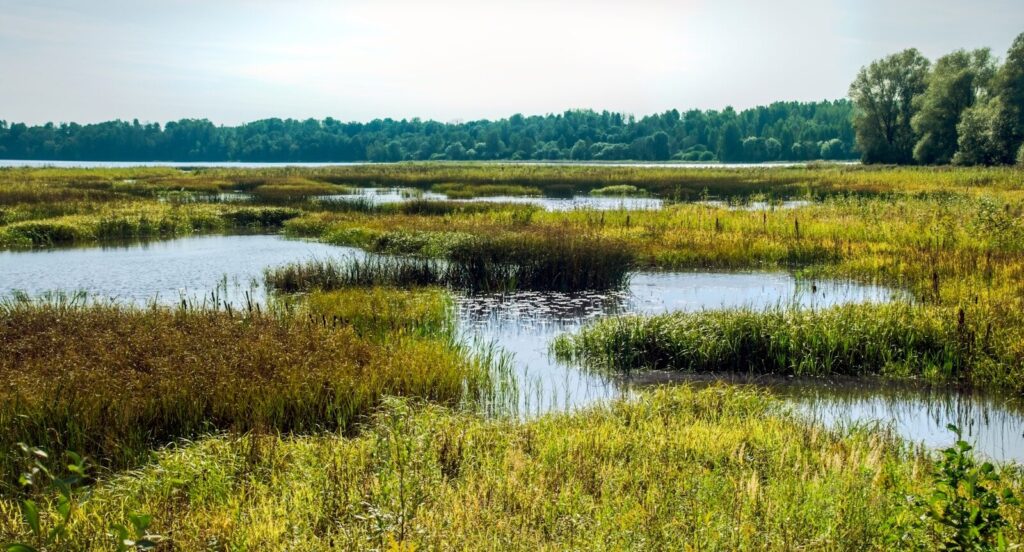
Restored wetlands act as vital carbon sinks and natural flood management systems.
The Architecture of the LINC Cornwall Carbon Offsetting Tool
The fundamental premise of the LINC Cornwall carbon offsetting tool rests on the concept of natural capital valuation. Developed through a collaboration between Cornwall Council, EnTrade, and Arup, the platform operates as an online nature market. It translates complex ecological restoration into quantifiable environmental credits. This framework allows private entities to seamlessly fund verified, high-integrity projects.
Historically, environmental degradation has been treated as an economic externality. The LINC Cornwall carbon offsetting tool internalizes these costs by creating a legitimate marketplace for ecosystem services. Buyers purchase credits to offset their operational impacts, while suppliers—typically farmers and landowners—receive necessary funding to execute conservation efforts. This creates a circular, regenerative economic loop.
To ensure scientific integrity, the platform utilizes advanced allocation mechanisms to price environmental benefits accurately. By quantifying metrics such as soil carbon density and water nutrient loads, the system guarantees that corporate investments translate into real-world biophysical improvements..
Connecting this localized market to global climate systems reveals its true value. The biosphere functions as a series of interconnected carbon sinks and sources. When the LINC Cornwall carbon offsetting tool facilitates the planting of native woodlands, it actively manipulates the regional carbon cycle. This directly mitigates the thermodynamic imbalances driving global temperature anomalies.
How the LINC Cornwall Carbon Offsetting Tool Restores Habitats
The practical application of the LINC Cornwall carbon offsetting tool is evident in its diverse portfolio of nature recovery projects. These initiatives extend far beyond simple tree planting. They encompass complex ecological interventions designed to restore systemic balance. Some of the primary focus areas include:
- Catchment Roughening: Introducing natural friction to slow water flow, thereby reducing flood risks and allowing for groundwater recharge.
- Peatland Restoration: Re-wetting degraded bogs to prevent the oxidation of ancient organic matter, effectively halting mass carbon release.
- Seagrass Meadow Recovery: Cultivating marine plants that capture carbon at rates significantly higher than terrestrial forests.
- Regenerative Agriculture: Transitioning farming practices to enhance soil microbiome health and increase long-term crop resilience.
By funding these specific interventions, the LINC Cornwall carbon offsetting tool directly addresses both the climate and biodiversity crises simultaneously. We can view these projects as localized ecological medicine. They repair the fractured biological networks that regulate our planet’s baseline atmospheric chemistry.
This cluster of regional initiatives is setting the standard for future ecological governance. The success of Cornwall’s model provides a scalable blueprint for other regions facing similar environmental vulnerabilities.
The Financial Mechanics of Natural Capital
Transitioning from an extractive economy to a restorative one requires rigorous financial engineering. The LINC Cornwall carbon offsetting tool utilizes a unique matching system to pair buyers with the most appropriate local projects. This ensures that capital flows efficiently toward the areas of highest ecological need. The mechanism reduces transaction friction and maximizes the actual percentage of funds reaching the soil.
Unlike international, voluntary carbon markets that often rely on vague avoidance metrics, Cornwall’s Natural Capital Exchange emphasizes tangible, local additionality. Additionality means the ecological benefit would not have occurred without the specific financial intervention. This strict standard prevents greenwashing and ensures corporate accountability.
To illustrate the systemic advantages of this regional approach, consider the following data comparison. It highlights the structural differences between conventional offsets and localized natural capital exchanges.
| Metric / Feature | Traditional Voluntary Offsets | LINC Cornwall carbon offsetting tool |
| Spatial Verification | Often remote, difficult to audit. | Hyper-local, physically verifiable by stakeholders. |
| Ecological Focus | Primarily singular (Carbon equivalence). | Multi-dimensional (Carbon, Water, Biodiversity). |
| Economic Beneficiary | International brokers and distant developers. | Local farmers, conservationists, and regional economies. |
| Systemic Impact | Abstract atmospheric mitigation. | Tangible climate resilience and local flood prevention. |
This data table underscores why the LINC Cornwall carbon offsetting tool represents a paradigm shift. It moves the focus from mere carbon accounting to holistic ecosystem regeneration. By stacking multiple environmental benefits into a single funded project, the region maximizes its return on ecological investment. You can find further authoritative data on environmental economics via the University of Exeter’s Land, Environment, Economics and Policy Institute.
Engaging Landowners and Corporate Stakeholders
The ultimate success of the LINC Cornwall carbon offsetting tool hinges on its ability to incentivize local landowners. Farmers manage the vast majority of the UK’s physical landscape. Without their active participation, systemic ecological recovery is physically impossible. The platform provides them with a viable, long-term alternative revenue stream.
By treating ecosystem services as a legitimate cash crop, the LINC Cornwall carbon offsetting tool aligns agricultural economics with planetary boundaries. Landowners are financially rewarded for adopting sustainable land management practices. This economic security allows them to experiment with restorative techniques that might otherwise carry prohibitive short-term financial risks.
Corporate stakeholders benefit equally from this transparent arrangement. Businesses are facing increasing regulatory pressure to disclose and mitigate their environmental impacts. Participating in this localized market provides them with robust, defensible data for their Environmental, Social, and Governance (ESG) reporting. It also fosters goodwill within the communities where they operate.
Assessing the Viability of Regional Nature Markets
The deployment of the LINC Cornwall carbon offsetting tool is not without its systemic challenges. Establishing a highly functioning nature market requires robust baseline data, ongoing monitoring, and sophisticated legal frameworks. Ensuring that environmental credits represent permanent, irreversible improvements remains a complex scientific undertaking. The natural world is dynamic, and interventions carry inherent biological risks.
However, the Department for Environment, Food & Rural Affairs has recognized the necessity of these pilot programs. Their financial backing indicates a significant shift in national environmental strategy. The goal is to raise billions in private finance for nature recovery by 2030. The LINC Cornwall carbon offsetting tool is serving as a critical testing ground for this national ambition.
This framework provides the essential guardrails that maintain market integrity and prevent the financialization of nature from leading to adverse ecological outcomes.
When we zoom out, the necessity of the LINC Cornwall carbon offsetting tool becomes undeniably clear. Our current global economic model systematically undervalues the foundational earth systems that sustain human life. By creating a localized, highly regulated mechanism to price and protect these assets, Cornwall is addressing the root cause of the ecological crisis, not just its symptoms.
Conclusion: A Paradigm Shift in Ecological Economics
The emergence of the LINC Cornwall carbon offsetting tool signals a critical maturation in how we approach climate mitigation. It demonstrates that the path to global atmospheric stability runs directly through local ecological restoration. By bridging the gap between high-level green finance and grassroots conservation, this platform offers a deeply pragmatic solution to a complex systemic threat.
Ultimately, the true value of the LINC Cornwall carbon offsetting tool lies in its potential for replication. As the methodology for valuing natural capital becomes more refined, similar localized markets can be deployed globally. This decentralized approach to environmental repair may prove to be our most effective mechanism for securing long-term planetary resilience.
Authoritative Source: Bureau of Reclamation – Water Data
Water Footprint Impact Calculator
Measure direct and virtual water consumption across household, agricultural, and industrial supply chains against regional watershed stress metrics.
Calculate Water Footprint →