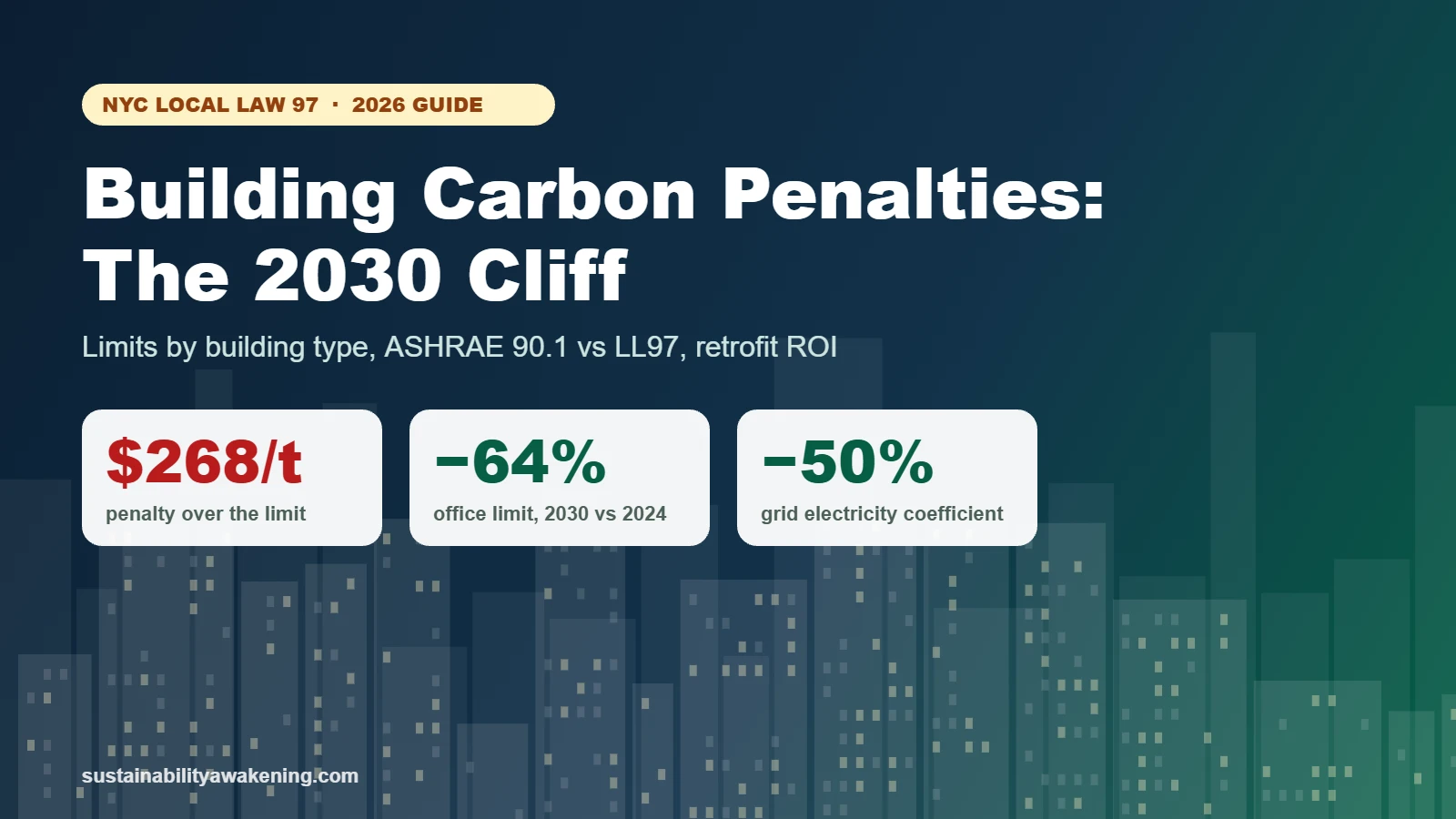
New York City now prices building carbon at $268 a tonne, and the hard part has not started yet. Local Law 97 (LL97) caps the annual greenhouse gas emissions of most buildings over 25,000 square feet. The first limits, for 2024 to 2029, were set so that most buildings could pass. From 2030 the limits for most property types fall by more than half, and many offices, hotels and apartment buildings that comply today will owe penalties every year unless they cut emissions first.
This guide is for owners, energy managers and corporate ESG teams with New York real estate. It explains who is covered, how the penalty is calculated, what changes in 2030, how LL97 differs from the ASHRAE 90.1 energy standard and which retrofits move the number. To test your own building, use our free Local Law 97 Carbon Penalty Modeler. For the short version, see the Local Law 97 web story.
Local Law 97 at a glance
The numbers that drive building decarbonization budgets in New York.
- What Local Law 97 requires in 2026
- Which buildings are covered, and on which pathway
- How the penalty is calculated
- The 2030 cliff: limits by building type
- ASHRAE 90.1 and LL97: design efficiency versus operating carbon
- Retrofit levers and what they do to the number
- Compliance tools beyond retrofits
- Beyond New York: why this matters for corporate ESG teams
- A 2026–2030 action plan
- Frequently asked questions
What Local Law 97 requires in 2026
LL97 was passed in 2019 as part of New York’s Climate Mobilization Act. Its goal is to cut emissions from the city’s largest buildings by 40% by 2030 and to net zero by 2050 (NYC Department of Buildings). Buildings account for over two thirds of the city’s greenhouse gas emissions, so the law targets the biggest single source.
Each covered building gets an annual emissions limit based on its floor area and use. Each year the owner calculates the building’s actual emissions from its energy bills, using fixed coefficients for each fuel. If emissions exceed the limit, the owner pays a penalty on the difference. A registered design professional must certify the report.
The first compliance year was 2024. Those reports were due on 31 December 2025, and in April 2026 the city said about 93% of covered privately owned properties, representing 91% of covered buildings, had filed. Around 1,400 properties that did not file now face enforcement, and the Department of Buildings is auditing filings from about 28,000 buildings (NYC DOB, 22 April 2026). Reports for calendar year 2025 were due on 1 May 2026, with a grace period to 30 June and extensions available to 29 August.
Which buildings are covered, and on which pathway
Coverage is set by floor area as recorded by the city’s Department of Finance. LL97 covers:
- a single building over 25,000 gross square feet;
- two or more buildings on the same tax lot that together exceed 50,000 square feet; and
- two or more condominium buildings governed by the same board of managers that together exceed 50,000 square feet.
Not every covered building faces the same rules. The DOB assigns each building a compliance pathway on its Covered Buildings List, which it updated in March 2026:
| Pathway | Who | What it means |
|---|---|---|
| Article 320, from 2024 | Most private buildings | Annual emissions limits and reports |
| Article 320, from 2026 | Certain buildings with income-restricted units | Annual limits start in 2026 |
| Article 320, from 2035 | Certain buildings with rent-regulated units | Annual limits start in 2035 |
| Article 321 | Buildings over 35% rent regulated, some federal housing programmes, houses of worship | One-time prescriptive energy measures instead of limits |
Source: NYC Department of Buildings, LL97 Covered Buildings List and compliance pathways. Check your building’s pathway on the current list.
Owners should check their building on the current list. If the floor area, use or pathway is wrong, they can dispute it through the LL97 reporting portal before relying on any calculation.
How the penalty is calculated
The calculation has three parts: the limit, the emissions and the penalty.
The limit is the gross floor area multiplied by an emissions factor for the building’s ENERGY STAR Portfolio Manager property type, set in the DOB rule 1 RCNY §103-14. Mixed-use buildings add up the limit for each use by its floor area.
The emissions are each fuel’s annual use multiplied by a fixed coefficient. For 2024 to 2029, grid electricity counts as 0.000288962 tCO₂e per kWh, natural gas as 0.00005311 tCO₂e per kBtu, No. 2 fuel oil as 0.00007421 and district steam as 0.00004493 (DOB Article 320 guide). For 2030 to 2034 the rule sets grid electricity at 0.000145 tCO₂e per kWh and district steam at 0.0000432, while gas and oil stay the same (1 RCNY §103-14).
The penalty is $268 for each tonne over the limit, every year the building is over. Separately, not filing costs $0.50 per square foot for each month the report is late.
A worked example
Take a 250,000 square foot Manhattan office that uses 14 kWh of grid electricity and 30 kBtu of natural gas per square foot each year.
| 2024–2029 | 2030–2034 | |
|---|---|---|
| Electricity emissions | 1,011 t | 508 t |
| Gas emissions | 398 t | 398 t |
| Total emissions | 1,410 t | 906 t |
| Limit | 1,895 t | 673 t |
| Over the limit | None | 233 t |
| Annual penalty | $0 | $62,474 |
Illustrative building. Office limits of 0.00758 tCO₂e/sf (2024–2029) and 0.002690852 tCO₂e/sf (2030–2034) from 1 RCNY §103-14.
The building passes easily today, with almost 500 tonnes of headroom. In 2030 it owes about $62,000 a year, or more than $300,000 over the five-year period, without any change in how it runs. The cleaner grid coefficient halves its electricity emissions, but the limit falls even faster. Its gas boilers, untouched by the coefficient change, become the problem. You can rerun this example with your own numbers in the LL97 modeler.
The 2030 cliff: limits by building type
The 2030 limits are where the law bites. For most property types the per-square-foot factor falls by 50% to 80% compared with 2024 to 2029:
| Property type | 2024–2029 | 2030–2034 | Change |
|---|---|---|---|
| Office | 7.58 | 2.69 | −65% |
| Hotel | 9.87 | 3.85 | −61% |
| Multifamily housing | 6.75 | 3.35 | −50% |
| Retail store | 7.58 | 2.10 | −72% |
| K-12 school | 6.75 | 2.23 | −67% |
| Hospital (general medical & surgical) | 23.81 | 7.34 | −69% |
| Non-refrigerated warehouse | 4.26 | 0.88 | −79% |
| Data center | 23.81 | 14.79 | −38% |
| Laboratory | 23.81 | 26.03 | +9% |
Source: 1 RCNY §103-14 emissions factors by ENERGY STAR Portfolio Manager property type, converted from tCO₂e per sq ft. Limits continue to fall in 2035–2039 and 2040–2049.
Three patterns stand out. First, offices, retail and warehouses face the steepest cuts, so even efficient buildings that heat with gas will struggle. Second, energy-intensive uses with little room to cut, such as laboratories, keep relatively high limits. Third, the halving of the electricity coefficient means an all-electric building’s emissions fall by about half in 2030 on paper, while a gas-heated building’s fall far less. That is why electrification sits at the centre of most LL97 plans.
Limits keep tightening after 2034. The rule already sets factors for 2035–2039 and 2040–2049. For offices, the 2040 factor is about 0.58 kg per square foot, less than a tenth of the 2024 level.
ASHRAE 90.1 and LL97: design efficiency versus operating carbon
Many owners assume a building that meets the energy code also meets LL97. It does not, because the two rules measure different things.
ASHRAE/IES Standard 90.1 is the US model energy standard for commercial buildings. It sets minimum efficiency for envelopes, HVAC, lighting and power in new construction and major alterations, and state energy codes are built on it. In March 2024 the US Department of Energy determined that the 2022 edition would save about 9.8% of site energy, 9.4% of source energy and 9.3% of carbon emissions compared with the 2019 edition (US DOE Building Energy Codes Program). The 2022 edition also added a new section that requires buildings to earn energy credits from a menu of extra measures.
LL97 does not care how a building was designed. It caps the carbon the building actually produces each year, based on metered fuel and electricity. A building designed to 90.1 can still exceed its limit if it burns gas for heat and hot water, runs long hours, or drifts out of tune.
| ASHRAE 90.1 | Local Law 97 | |
|---|---|---|
| What it regulates | Design efficiency | Operating greenhouse gas emissions |
| When it applies | New buildings and major alterations | Every year, for existing covered buildings |
| Metric | Prescriptive rules or modelled energy cost | tCO₂e per sq ft from metered energy |
| Fuel choice | Largely neutral | Strongly favours electricity from 2030 |
| Consequence | Permit approval | $268 per tonne over the limit each year |
In practice the two work together. Use 90.1, or a stricter local code, as the design floor for any retrofit. Use LL97 to decide which measures to fund first and when.
Retrofit levers and what they do to the number
Retrofits fall into four groups. Their effect on the LL97 number depends on which fuel they cut and which compliance period you are in.
- Operations and retro-commissioning. Fixing schedules, set points, simultaneous heating and cooling, and controls is the cheapest step, often a few percent of energy for well under $1 per square foot. New York already requires periodic energy audits and retro-commissioning under Local Law 87.
- Lighting and plug loads. LED lighting with occupancy and daylight controls cuts electricity. Its LL97 value roughly halves in 2030, because each kWh then counts for half as much carbon.
- Envelope. Window replacement, secondary glazing, air sealing and roof insulation cut heating and cooling loads. They are expensive per tonne but reduce the size of the heat pumps you need later.
- Electrification. Air-source or water-source heat pumps for space heating and heat pump water heaters replace gas, oil or steam. A heat pump with a seasonal efficiency of about 3 moves most heating emissions onto the grid coefficient, which halves in 2030. This is usually the measure that gets gas-heated buildings under their 2030 limits.
Two companions matter. Batteries do not change LL97 emissions on their own, but they can cut demand charges and make electrification more affordable; see our battery storage ROI calculator. On-site solar and qualifying storage can be counted as distributed energy resource deductions under the rule.
The modeler’s default package of LED lighting and retro-commissioning cuts the example office’s 2030 penalty from about $62,000 to about $24,000 a year, with a payback of about five years at assumed prices. Adding heat-pump electrification removes the 2030 penalty entirely but costs far more. Try the combinations in the modeler.
Compliance tools beyond retrofits
Retrofits are the long-term answer, but LL97 includes other ways to close a gap:
- Offsets. The only eligible offsets are certificates from the city’s Affordable Housing Reinvestment Fund. They cost $268 per tonne, the same as the penalty, and are capped at 10% of a building’s emissions limit. By April 2026 they had raised $1,460,048 for energy projects in affordable housing.
- Renewable energy certificates. RECs that meet DOB’s LL97 REC policy can be deducted against grid electricity emissions.
- Deductions and alternatives. These cover on-site and off-site solar and storage, beneficial electrification, EV chargers, campus energy systems, time-of-use electricity accounting and approved biofuels.
- Adjustments. Owners facing capital or financial constraints can apply for a limit adjustment under §320.7. Applications under §320.8 and §320.9 closed on 1 January 2025.
- Good faith efforts. For the early years, the rule allowed owners who filed a certified decarbonization plan by 1 May 2025, and are carrying it out, to seek penalty mitigation.
Treat these as bridges, not destinations. Offsets and RECs cost money every year and do not reduce the building’s exposure to the steeper 2035 and 2040 limits.
Beyond New York: why this matters for corporate ESG teams
LL97 is the largest building performance standard in the US, but it is not the only one. Boston’s BERDO sets emissions standards for large buildings from 2025, with an alternative compliance payment of $234 per tonne. Other cities and states have similar laws, so a portfolio approach pays off.
For corporate ESG teams, building emissions are mostly Scope 1 (on-site gas, oil and steam boilers) and Scope 2 (electricity and purchased steam). Leased offices may instead sit in Scope 3 Categories 8 and 13, depending on your boundary; our Scope 3 supply chain guide explains how. The same retrofits that cut an LL97 penalty also cut reported emissions and support a science-based target. Start a baseline in our free GHG Emissions Engine.
Asia-Pacific portfolios face a parallel squeeze through carbon pricing rather than building caps. Singapore’s carbon tax rose to S$45 per tonne in 2026, and listed companies there now report Scope 1 and 2 under ISSB-based rules; see our Singapore carbon tax guide. A multinational with offices in New York and Singapore can plan both with one building-level data set.
A 2026–2030 action plan
| When | Action | Output |
|---|---|---|
| Now | Confirm coverage, pathway and floor area on the 2026 Covered Buildings List | Correct baseline; disputes filed if needed |
| Q4 2026 | Model 2024–2049 emissions and penalties by fuel | Penalty exposure by period |
| Q1 2027 | Energy audit and retro-commissioning; quick operational fixes | Low-cost savings and a measure list |
| 2027 | Design electrification and envelope measures to 90.1 or the local code | Costed retrofit plan with incentives |
| 2027–2029 | Install, sequencing work with equipment end of life | Building under its 2030 limit |
| Every 1 May | File the certified annual report | No late-filing penalty |
Large buildings typically need 18 to 36 months from audit to commissioning for heating plant replacements.
Frequently asked questions
How much is the Local Law 97 penalty?
The penalty is $268 for every metric tonne of CO2e a covered building emits above its annual limit, for each calendar year it is over. Separately, failing to file the annual report costs $0.50 per gross square foot for each month the report is late, within the 12 months after the May 1 deadline.
When are Local Law 97 reports due?
Reports for each calendar year are due on May 1 of the following year, with a 60-day grace period to June 30, and owners can apply for an extension to August 29. The first reports, covering 2024, were due on December 31, 2025. Reports for 2025 were due on May 1, 2026.
Which buildings does Local Law 97 cover?
Most buildings over 25,000 gross square feet, two or more buildings on the same tax lot that together exceed 50,000 square feet, and two or more condominium buildings governed by the same board that together exceed 50,000 square feet. Some buildings, such as certain affordable housing and houses of worship, follow a one-time prescriptive pathway under Article 321 instead of emissions limits.
Why do LL97 limits get so much stricter in 2030?
The law targets a 40% cut in emissions from large buildings by 2030 and net zero by 2050. For 2030 to 2034 the per-square-foot limits for most property types fall by 50% to 80% compared with 2024 to 2029. The electricity coefficient also halves, from 0.000288962 to 0.000145 tCO2e per kWh, which rewards buildings that electrify heating.
Can carbon offsets or RECs be used for LL97 compliance?
Partly. The only eligible offsets are certificates from the city’s Affordable Housing Reinvestment Fund, priced at $268 per tonne and capped at 10% of a building’s emissions limit. Renewable energy certificates that meet DOB’s LL97 REC policy can be deducted against grid electricity emissions. Neither replaces the need to cut on-site fossil fuel use over time.
Is ASHRAE 90.1 compliance enough to meet Local Law 97?
No. ASHRAE 90.1 sets minimum efficiency for the design of new buildings and major alterations. LL97 caps the actual greenhouse gas emissions a building produces each year in operation. A building designed to 90.1 can still exceed its LL97 limit if it burns gas or oil for heat, runs long hours or is poorly operated.
Sources
- NYC Department of Buildings, LL97 Greenhouse Gas Emissions Reduction
- NYC DOB, New compliance data shows impact of Local Law 97 (22 Apr 2026)
- NYC DOB, 1 RCNY §103-14: emissions factors and 2030–2034 coefficients
- NYC DOB, Article 320 Information Guide
- US DOE Building Energy Codes Program, model energy code determinations
- City of Boston, Building Emissions Reduction and Disclosure Ordinance (BERDO)
This guide is for general information and is not legal or engineering advice. Confirm your building’s obligations with a registered design professional and the current DOB rules.
Water Footprint Impact Calculator
Measure direct and virtual water consumption across household, agricultural, and industrial supply chains against regional watershed stress metrics.
Calculate Water Footprint →