Americans may have more ‘forever chemicals’ in their tap water than official reports suggest. A study published on 23 October 2026 found that the usual way of summarising federal PFAS test results captures less than half of the average concentration, because almost every low reading is counted as zero. The finding lands in the same year that the US Environmental Protection Agency (EPA) proposed delaying and narrowing its first national PFAS drinking-water limits.
This guide explains what the study found, how to read a ‘not detected’ result, where federal rules stand in October 2026, and what households, utilities and companies can do now. The 11-slide web story version summarises the key numbers.
- What the new study found
- Why not detected does not mean zero
- The numbers at a glance
- What PFAS are and why the health goal is zero
- The 2026 rule changes
- What households can do
- What utilities and companies should do
- Frequently asked questions
What the new study found
The study, led by Gehendra Kharel of Texas Christian University and published in Cell Reports Sustainability, analysed more than 1.8 million PFAS test records from EPA’s national drinking-water monitoring programme, the Fifth Unregulated Contaminant Monitoring Rule (UCMR 5). EPA published a near-complete release of that data in January 2026.
The team found that about 98% of individual results were below the laboratory minimum reporting level (MRL) and recorded as ‘<MRL’. When those values are treated as zero, as they usually are in averages, the picture changes dramatically. Using censoring-aware statistical models that generated 500 plausible values for each below-limit record, the researchers estimated that conventional summaries capture only 44% of the average concentration of the 25 PFAS detected at least once, across 9,991 community water systems.
For the six PFAS that EPA regulated in 2024, the national average rises from about 2.6 nanograms per litre (equivalent to parts per trillion, ppt) to about 5.2 when the hidden values are estimated. “When a water quality report says ‘not detected,’ that means below the reporting limit, not zero,” Kharel said in the Cell Press release. The authors are clear that these are model predictions, not new measurements, and that the study does not show individual systems breaking federal limits.
Why not detected does not mean zero
A minimum reporting level is a laboratory concept, not a safety threshold. It is the lowest concentration that most accredited labs can measure reliably. Under UCMR 5, EPA requires systems to test for 29 PFAS (plus lithium), with MRLs between 2 and 20 ppt depending on the chemical. Anything below that line is reported as a non-detect.
Treating non-detects as zero is convenient but biased: it assumes the water is clean whenever the lab cannot be sure. Statisticians call such data ‘left-censored’, and established methods exist to estimate what lies below the limit. The new study applies those methods at national scale. It matters most for chemicals whose reporting limit sits close to the level of health concern. For PFOA and PFOS, the MRL is 4 ppt, the same as the enforceable limit, while the health-based goal is zero.
The numbers at a glance
| Measure | Value | What it means |
|---|---|---|
| Test records analysed | 1.8 million+ | EPA UCMR 5 national dataset (January 2026 release) |
| Results below reporting limits | ~98% | Recorded as ‘<MRL’ and usually counted as zero |
| Share of average concentration captured | 44% | 25 PFAS detected at least once, 9,991 community water systems |
| Six regulated PFAS, conventional average | 2.6 ppt | Below-limit results counted as zero |
| Six regulated PFAS, modelled average | 5.2 ppt | Censoring-aware estimate, about twice as high |
| UCMR 5 reporting limits | 2–20 ppt | Laboratory capability, not a health threshold |
| PFOA and PFOS enforceable limit (MCL) | 4 ppt each | Health-based goal (MCLG) is zero |
Sources: Kharel et al., Cell Reports Sustainability (23 Oct 2026); EPA UCMR 5. 1 ppt = 1 nanogram per litre.
An Environmental Working Group analysis cited in the release estimates that about 176 million Americans are served by systems where at least one PFAS was detected. The new study suggests that the low-level background in many other systems is under-counted.
What PFAS are and why the health goal is zero
PFAS (per- and polyfluoroalkyl substances) are a family of thousands of synthetic chemicals used since the 1940s in nonstick cookware, stain- and water-resistant fabrics, food packaging and firefighting foam. Their carbon–fluorine bonds make them extremely persistent, which is why they are called forever chemicals. They reach drinking water from industrial discharges, airports and military bases that used foam, landfills and wastewater. Our earlier article on the first federal PFAS limits covers the background.
Exposure to certain PFAS has been linked to kidney and testicular cancer, liver damage, raised cholesterol, reduced vaccine response and developmental effects in children. Because EPA found no safe level for PFOA and PFOS, their health-based goal is zero; the enforceable limit of 4 ppt reflects what can be reliably measured and treated.
The 2026 rule changes
In April 2024 EPA set the first national limits for six PFAS, with water systems required to comply by 2029. On 18 May 2026 the agency announced two proposed rules that would change that framework:
- Keep PFOA and PFOS at 4 ppt, but delay compliance. The proposed compliance extension rule would let eligible systems meet the limits by 2031 instead of 2029.
- Rescind four other limits. The proposed rescission rule would withdraw the 2024 limits for PFHxS, PFNA and HFPO-DA (GenX chemicals) and the ‘hazard index’ for mixtures of those three plus PFBS.
- States are filling gaps. Several states already enforce their own PFAS limits, some covering more compounds than the federal rule.
| Chemical | 2024 limit | May 2026 proposal |
|---|---|---|
| PFOA | 4 ppt | Keep; compliance to 2031 |
| PFOS | 4 ppt | Keep; compliance to 2031 |
| PFHxS | 10 ppt | Rescind |
| PFNA | 10 ppt | Rescind |
| HFPO-DA (GenX) | 10 ppt | Rescind |
| Mixtures (PFHxS, PFNA, HFPO-DA, PFBS) | Hazard index of 1 | Rescind |
Proposals are not final until EPA completes rulemaking. Status checked 25 October 2026.
Taken together with the new study, the policy direction raises a practical question for utilities: if the national average of regulated PFAS may be closer to 5 ppt than 2.6 ppt, monitoring with lower detection limits becomes more valuable, not less.
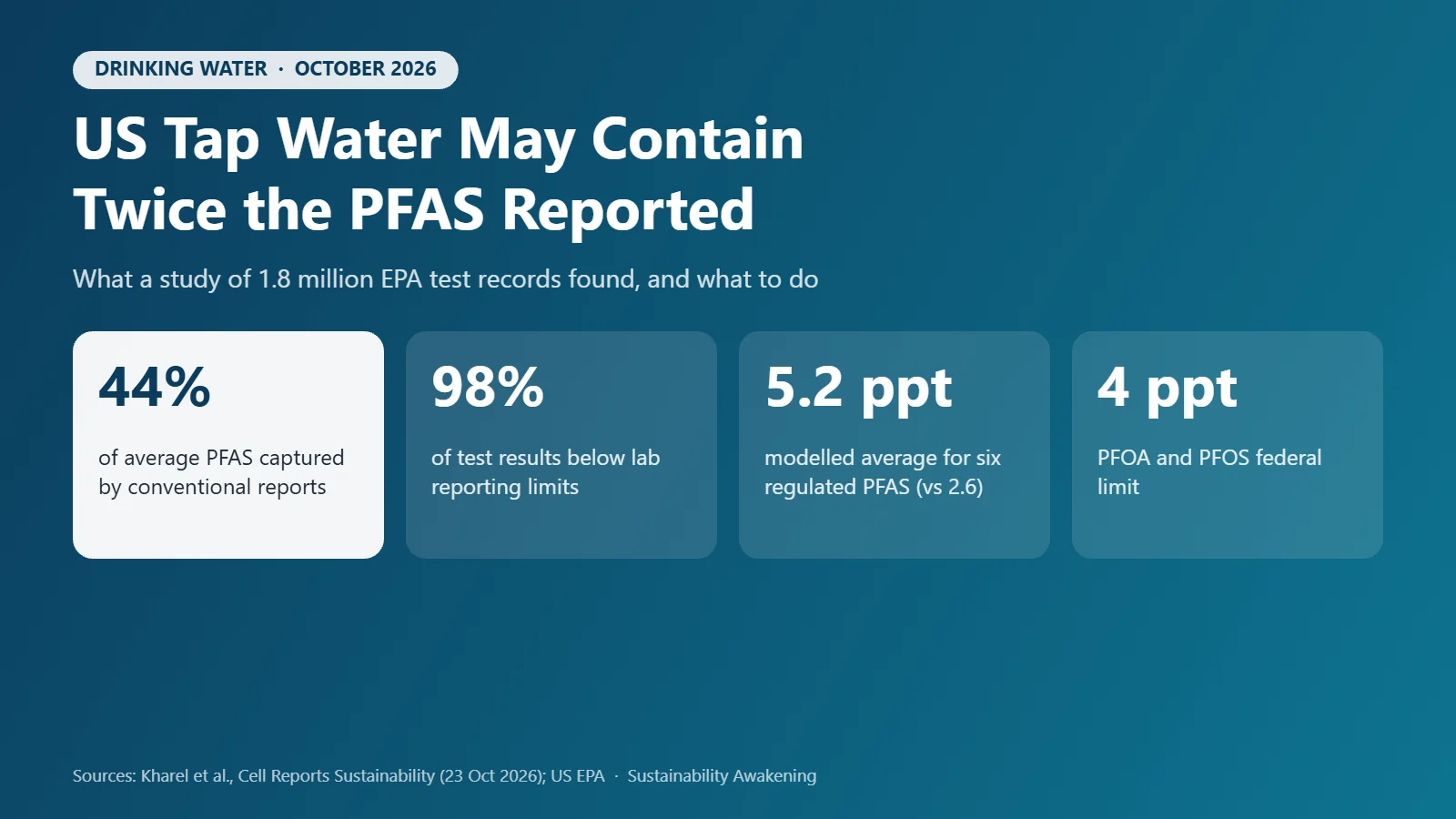
PFAS in US tap water at a glance
Key figures from the 23 October 2026 Cell Reports Sustainability study and EPA rules.
What households can do
- Read your utility’s report. Community water systems publish an annual Consumer Confidence Report. Look for PFAS results and the reporting limits used, and check EPA’s UCMR 5 data for your system.
- Treat ‘not detected’ as ‘below the limit’. If your system reported non-detects with a 4 ppt limit, low levels may still be present.
- Choose a certified filter if you want extra protection. EPA recommends products independently certified to NSF/ANSI 53 or 58 for PFAS reduction; search the NSF certified products listing for your exact model.
- Pitcher or under-sink? Certified pitchers and tap filters cost least; reverse osmosis removes more contaminants but wastes some water and needs maintenance.
- Replace cartridges on time. Saturated activated-carbon filters can stop removing PFAS.
- Do not assume bottled water is cleaner. It is regulated differently and is not guaranteed PFAS-free.
What utilities and companies should do
For utilities, the study is an argument for using lower laboratory detection limits where possible and for reporting below-limit statistics honestly. Proven treatment options are granular activated carbon, ion-exchange resins and high-pressure membranes such as reverse osmosis; each produces PFAS-laden waste that needs safe disposal.
For companies, PFAS are both a product-stewardship and a water-risk issue. Manufacturers that use PFAS face growing state bans and disclosure rules, and sites that discharge to municipal systems may face pre-treatment requirements. Water-intensive operations should include PFAS in site water-risk screening alongside scarcity, as described in our guides to corporate water replenishment and US water scarcity solutions.
Frequently asked questions
Does US tap water really contain twice as much PFAS as reported?
On average, possibly. A study published on 23 October 2026 in Cell Reports Sustainability found that 98% of 1.8 million EPA test results fell below laboratory reporting limits and were treated as zero. Modelling those hidden values suggests standard summaries capture only 44% of the average concentration of 25 PFAS, and that the average for the six regulated PFAS is about 5.2 parts per trillion rather than 2.6. These are model estimates, not new measurements, and they do not show that any particular system breaks federal limits.
What does ‘not detected’ mean on my water quality report?
It means the result was below the minimum reporting level, the smallest concentration most laboratories can reliably measure. For the 29 PFAS in EPA’s UCMR 5 programme these levels range from 2 to 20 parts per trillion. A ‘not detected’ result therefore means ‘below that limit’, not ‘zero’.
What are the federal PFAS limits for drinking water in 2026?
The enforceable limits for PFOA and PFOS remain 4 parts per trillion each, with a health-based goal of zero. In May 2026 EPA proposed to keep those limits but give eligible water systems until 2031 instead of 2029 to comply, and to rescind the 2024 limits for PFHxS, PFNA, HFPO-DA (GenX) and the hazard-index mixture. Both changes are proposals until EPA finalises them.
Which water filters remove PFAS?
Look for a filter independently certified to NSF/ANSI Standard 53 or 58 specifically for PFAS reduction. Certified pitcher and tap filters (Standard 53) are the cheapest option; under-sink reverse osmosis systems (Standard 58) remove a broader range of contaminants but cost more. Check the certification for your exact model and replace cartridges on schedule.
Should I stop drinking tap water because of PFAS?
Not necessarily. The study does not show that most systems exceed federal limits, and bottled water is not reliably PFAS-free. Start by reading your utility’s annual water quality report and EPA’s UCMR 5 results for your system; if PFAS were detected or you want extra protection, a certified filter is a cost-effective step.
Sources
- Kharel et al., Censoring-aware models quantify systematic underestimation of PFAS occurrence in U.S. drinking-water monitoring, Cell Reports Sustainability (23 Oct 2026)
- Cell Press release via EurekAlert (23 Oct 2026)
- Techlicious via Yahoo Health, US drinking water may contain twice the reported PFAS levels (23 Oct 2026)
- US EPA, Proposed PFOA and PFOS Compliance Extension Rule (May 2026)
- US EPA, Proposed PFAS Rescission Rule (May 2026)
- US EPA, Fifth Unregulated Contaminant Monitoring Rule (UCMR 5)
- NSF certified drinking water treatment units
This article is for general information and is not medical advice. Contact your water utility or state drinking-water programme about local results.
Water Footprint Impact Calculator
Measure direct and virtual water consumption across household, agricultural, and industrial supply chains against regional watershed stress metrics.
Calculate Water Footprint →