
Recent climate data reveals a sharp shift in our planetary trajectory. Global warming acceleration is a measurable and documented reality. Earth is currently warming at a rate of approximately 0.35 degrees Celsius per decade. This pace is nearly double the rate observed during the 1970s. The past three years have consistently shattered temperature records.
This rapid temperature increase demands immediate attention from policymakers, investors, and citizens alike. Understanding the mechanisms driving global warming acceleration is essential for developing effective climate strategies. Without aggressive interventions, the planet is on track to permanently breach the 1.5 degrees Celsius threshold set by the Paris Agreement by 2030.
This article examines the scientific foundation of this rapid warming trend. We will explore the specific environmental consequences and cascading economic impacts. Furthermore, we provide evidence-based solutions to mitigate these risks and stabilize our climate system.
Table of Contents
Key Concepts and Scientific Foundation
To grasp the severity of global warming acceleration, we must examine the underlying atmospheric mechanisms. The primary driver remains the continuous accumulation of greenhouse gases from fossil fuels. However, secondary factors are now amplifying this baseline warming effect.
The Aerosol Masking Effect
One major factor contributing to recent global warming acceleration is a paradoxical success in environmental policy. Recent regulations targeting international shipping have drastically reduced air pollution. Ships now emit significantly lower levels of sulfur dioxide.
Historically, these sulfur particles created reflective clouds over the oceans. This phenomenon, known as the aerosol masking effect, bounced incoming solar radiation back into space. The sudden reduction in these reflective particles has allowed more solar energy to reach the ocean surface. Consequently, this has triggered a rapid spike in global temperatures.
Differentiating Climate Fluctuations from Trends
Scientists must isolate long-term trends from natural climate fluctuations. Weather phenomena like El Niño temporarily boost global temperatures by releasing oceanic heat into the atmosphere. The extreme heat observed in 2023 and 2024 was partially driven by a strong El Niño phase.
However, advanced statistical models now remove these temporary anomalies from the data. Even after subtracting the influence of El Niño, the baseline rate of warming shows a clear upward trajectory. This confirms that global warming acceleration is a structural change in the climate system, not a temporary weather anomaly.
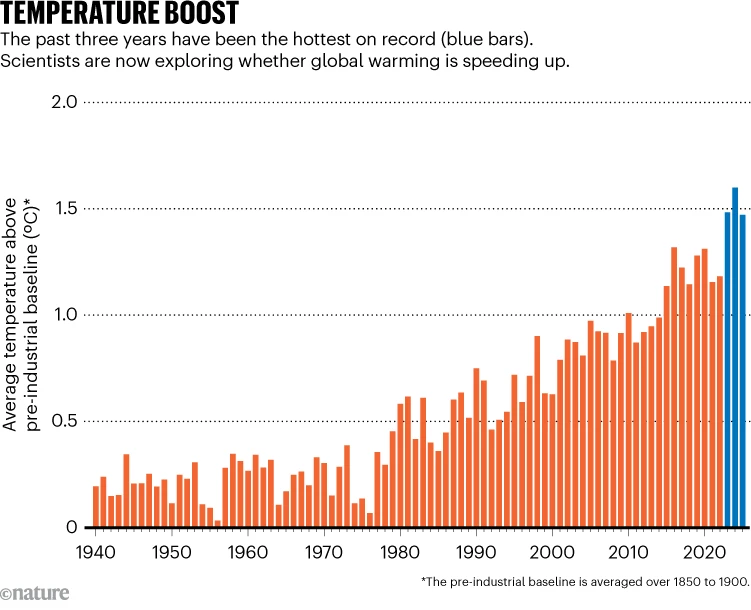
Description: A graph illustrating the steep upward curve of global surface temperatures from 1970 to 2026, highlighting the recent acceleration phase.
Environmental and Economic Impacts
The consequences of a rapidly warming planet extend far beyond rising thermometer readings. Global warming acceleration is actively destabilizing ecological systems and global financial markets.
Ecological Consequences and Extreme Weather Events
Higher baseline temperatures directly correlate with an increase in extreme weather events. The atmosphere now holds significantly more moisture. This increased moisture capacity fuels devastating storms, prolonged droughts, and catastrophic flooding.
In 2025 alone, extreme weather displaced millions of people globally. Ocean heat waves are simultaneously triggering massive coral bleaching events. These marine ecosystems are vital for global biodiversity and coastal protection. The accelerated warming rate leaves ecosystems with insufficient time to adapt to their changing environments.
Financial Implications and Systemic Risk
The economic costs of global warming acceleration are compounding annually. Supply chains face constant disruptions from unpredictable weather patterns. Agricultural yields in vulnerable regions are declining due to heat stress and water scarcity.
Furthermore, the insurance industry is experiencing unprecedented strain. Rising payouts for flood and fire damage are driving insurance premiums to unsustainable levels in coastal and forested regions. Investors are increasingly factoring physical climate risks into asset valuations. The failure to curb the climate change rate threatens long-term global macroeconomic stability.
Real World Case Studies and Applications
Examining localized data helps illustrate the broader mechanisms of climate change. Specific regions and industries provide clear examples of how global warming acceleration manifests in the real world.
The IMO 2020 Shipping Regulations
The International Maritime Organization implemented strict sulfur emission limits in 2020. This policy successfully improved air quality for coastal communities. However, it also provided a real-world experiment in climate sensitivity.
Marine regions heavily trafficked by cargo ships experienced rapid localized warming shortly after the regulations took effect. This case study perfectly illustrates the complex feedback loops within our climate system. It highlights why emissions reductions must target greenhouse gases and aerosols simultaneously to prevent unintended warming spikes.
Regional Warming Hotspots
Global warming acceleration is not occurring uniformly across the globe. Recent climatology data identifies specific regional hotspots experiencing faster-than-average temperature increases. Southeast China and Southeast Mexico are prominent examples.
These regions have aggressively reduced local smog and industrial air pollution over the last decade. As the protective layer of particulate matter dissipated, localized warming rates spiked. These regional case studies confirm the powerful masking effect of air pollution and the hidden heat already trapped in the climate system.
Challenges and Barriers to Mitigation
Transitioning away from carbon-intensive economies requires overcoming significant hurdles. Recognizing these barriers is the first step toward dismantling them.
Political and Policy Obstacles
Inconsistent political leadership remains a massive barrier to climate action. Fossil fuel subsidies continue to distort energy markets and disincentivize clean energy investments. Additionally, international climate agreements often lack enforceable compliance mechanisms. This allows major emitting nations to delay necessary policy reforms without immediate geopolitical consequences.
Economic and Technical Barriers
Scaling up renewable energy infrastructure requires massive upfront capital. Developing nations often lack access to affordable financing for these green transition projects.
Furthermore, upgrading national power grids to handle decentralized, intermittent renewable energy presents a major technical challenge. High-capacity battery storage and smart grid technologies are advancing rapidly. However, their deployment is not yet fast enough to match the pace of global warming acceleration.
Solutions and Strategic Pathways
Addressing the climate crisis requires a multi-faceted approach. We must implement aggressive, evidence-based solutions across all sectors of the global economy.
Policy Reform and Carbon Pricing
Governments must implement robust carbon pricing mechanisms. Taxing carbon emissions forces industries to internalize the environmental costs of their operations. Revenue generated from carbon taxes can fund renewable energy subsidies and climate adaptation projects.
Furthermore, governments must mandate a strict timetable for fossil fuel phaseout. Phasing out coal-fired power plants and banning the sale of new internal combustion engine vehicles are critical policy steps.
Industry Transformation and Technology
The corporate sector must rapidly decarbonize its supply chains. This involves transitioning to green hydrogen for heavy industry and electrifying transportation networks.
Agricultural practices must also shift toward regenerative models. Improving soil health increases carbon sequestration and enhances crop resilience against extreme weather. Furthermore, investing in next-generation carbon capture technologies is necessary to remove legacy emissions from the atmosphere.
Individual Action Steps
While systemic change is paramount, individual actions still play a crucial role. Consumers can drive market demand for sustainable products.
- Transition to electric vehicles or prioritize public transportation.
- Install residential solar panels and energy-efficient appliances.
- Reduce dietary reliance on carbon-intensive industrial meat production.
- Vote for political candidates who prioritize aggressive climate legislation.
Frequently Asked Questions
Is global warming actually accelerating?
Yes. Extensive data analysis from major institutions confirms that the rate of temperature increase has surged. The current warming rate is approximately 0.35 degrees Celsius per decade, significantly higher than historical averages.
What is the main cause of global warming acceleration?
The primary cause is the continuous accumulation of greenhouse gases from fossil fuels. A major secondary factor is the recent reduction in global air pollution, which previously reflected solar radiation away from the Earth.
Can we still stop the acceleration of climate change?
We can stabilize the climate, but it requires immediate and drastic emissions reductions. Transitioning to renewable energy, implementing carbon pricing, and halting deforestation are proven methods to slow the climate change rate.
How does El Niño affect the warming trend?
El Niño is a natural climate fluctuation that temporarily raises global temperatures. While it contributed to record heat in recent years, statistical models show that underlying global warming acceleration continues even when El Niño is removed from the data.
Conclusion
The scientific evidence is unequivocal and actionable. Global warming acceleration presents a profound threat to ecological stability and economic security. The sudden reduction in aerosol masking has revealed the true extent of the heat trapped within our atmosphere. We can no longer afford incremental changes or delayed policy implementations.
Mitigating this crisis requires an immediate, coordinated global response. We must rapidly transition to renewable energy systems, enforce strict carbon pricing, and phase out fossil fuels. Addressing global warming acceleration is the defining challenge of our time, and the window for effective intervention is closing rapidly.
Authoritative Source: Bureau of Reclamation – Water Data
Water Footprint Impact Calculator
Measure direct and virtual water consumption across household, agricultural, and industrial supply chains against regional watershed stress metrics.
Calculate Water Footprint →