Mercury and Air Toxics Standard Rollback: Health, Climate, and Economic Implications
Published on February 23, 2026 by Dr. A. M.
Introduction
The Mercury and Air Toxics Standard rollback marks a significant shift in US environmental policy. In February 2026, the Environmental Protection Agency under the Trump administration announced plans to weaken federal limits on mercury and hazardous air pollutants from coal-fired power plants.
Mercury is a persistent, bioaccumulative neurotoxin. It impairs brain development in infants and children and increases cardiovascular and neurological risks in adults. The original Mercury and Air Toxics Standard reduced mercury emissions from power plants by about 90 percent since 2012.
Now, regulators argue that easing compliance burdens will support aging coal plants and meet rising electricity demand from artificial intelligence data centers. However, public health groups warn that the Mercury and Air Toxics Standard rollback could increase long-term health costs, particularly for vulnerable communities.
This article explains the science behind mercury pollution, the economic trade-offs, and what this policy shift means for energy security, public health, and environmental risk management.
Key Concepts and Scientific Foundation
What Is the Mercury and Air Toxics Standard
The Mercury and Air Toxics Standard, commonly known as MATS, was first implemented in 2012 under the Clean Air Act. It targeted hazardous air pollutants from coal- and oil-fired power plants.
These pollutants include:
- Mercury
- Arsenic
- Lead
- Nickel
- Acid gases
- Organic toxics such as dioxins and formaldehyde
In 2024, the previous administration strengthened limits, proposing a 70 percent reduction in allowable mercury emissions from coal plants and a two-thirds reduction in other toxic metals.
The current Mercury and Air Toxics Standard rollback would reverse key portions of those updated requirements.
How Mercury Affects Human Health
Mercury released from coal combustion enters the atmosphere and eventually deposits into soil and water bodies. There, microbes convert it into methylmercury, a highly toxic organic form.
Methylmercury accumulates in fish and seafood. When humans consume contaminated fish, mercury crosses the blood-brain barrier and the placenta.
Health impacts include:
- Impaired cognitive development in children
- Lower IQ and learning disabilities
- Cardiovascular disease in adults
- Immune system disruption
- Reproductive harm
Even low-level exposure during pregnancy can affect fetal brain development.
Why Coal Plants Are a Major Source
Coal-fired power plants are among the largest industrial sources of mercury emissions in the United States. Although coal now generates less than 20 percent of US electricity, it remains disproportionately responsible for hazardous air pollution.
Technologies such as activated carbon injection and flue gas desulfurization systems have significantly reduced emissions over the past decade. However, the Mercury and Air Toxics Standard rollback reduces pressure to maintain or upgrade these systems.
Environmental and Economic Impacts
Public Health Costs
Stronger MATS updates were projected to deliver approximately 420 million dollars in health cost savings through 2037. These savings stem from reduced hospital visits, fewer premature deaths, and improved developmental outcomes.
When mercury exposure increases, societal costs rise in multiple ways:
- Increased healthcare spending
- Special education services
- Reduced workforce productivity
- Lost lifetime earnings due to cognitive impairment
Children in low-income and minority communities face higher exposure risks due to proximity to industrial facilities and dietary reliance on local fish.
Environmental Consequences
Mercury does not degrade. Instead, it cycles through air, soil, and water systems for decades.
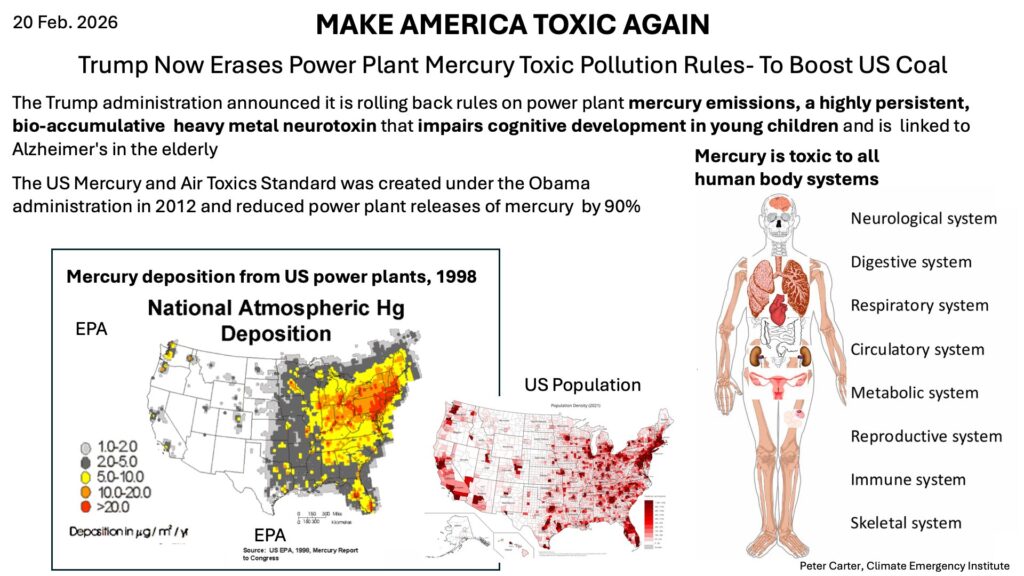
High deposition areas historically included the Midwest and Northeast, downwind of coal-heavy regions. The attached EPA map shows how atmospheric mercury deposition clustered near dense coal plant corridors. Overlaying population density maps highlights exposure risks in highly populated areas.
Ecosystems affected include:
- Freshwater lakes and rivers
- Coastal fisheries
- Wetlands
- Forest soils
Fish advisories remain widespread across US states due to mercury contamination.
Energy Market Implications
Supporters of the Mercury and Air Toxics Standard rollback argue that compliance costs strain older coal plants, especially during rising electricity demand from AI-driven data centers.
However, several trends complicate this claim:
- Coal plants continue to retire due to high operating costs
- Natural gas and renewables remain cheaper in most markets
- Grid reliability increasingly depends on diversified generation
Moreover, weakening environmental safeguards may shift costs from utilities to taxpayers through public health burdens.
Real World Case Studies and Applications
2012 Implementation Outcomes
After MATS took effect in 2012:
- Mercury emissions from power plants fell roughly 90 percent
- Acid gas emissions declined sharply
- Coal capacity decreased, but grid reliability remained stable
Many utilities installed pollution control technologies. Others retired inefficient units.
The transition demonstrated that regulatory certainty can drive innovation without destabilizing the power sector.
State-Level Impacts
States in the Ohio River Valley historically recorded high mercury deposition. These areas also contain large population centers and legacy industrial infrastructure.
Communities dependent on subsistence fishing face elevated methylmercury exposure risks.
Data Center Electricity Demand
Rising demand from artificial intelligence infrastructure is often cited as justification for the Mercury and Air Toxics Standard rollback.
However, alternative pathways exist:
- Accelerated renewable deployment
- Grid-scale battery storage
- Demand response systems
- Energy efficiency upgrades in data centers
Technology companies increasingly commit to carbon-free energy sourcing, which may limit long-term coal reliance.
Challenges and Barriers
Political Polarization
Environmental regulation remains politically contested. Energy security narratives often conflict with public health priorities.
Policy reversals create uncertainty for utilities and investors.
Aging Infrastructure
Many coal plants are more than 40 years old. Upgrading pollution controls requires capital investment, which operators may hesitate to commit without long-term regulatory clarity.
Economic Transition Concerns
Coal-dependent communities fear job losses and economic decline. Without robust transition planning, environmental reforms can face social resistance.
Legal Uncertainty
Previous MATS revisions survived Supreme Court review. However, regulatory authority shifts, including challenges to the endangerment finding, introduce uncertainty into future emissions governance.
Solutions and Strategic Pathways
Despite the Mercury and Air Toxics Standard rollback, evidence-based pathways remain available.
1. Strengthen State-Level Standards
States can adopt stricter mercury limits independent of federal rollbacks. Several states already enforce enhanced air toxics monitoring.
2. Expand Clean Energy Investment
Accelerating renewable energy and grid modernization reduces reliance on coal generation.
Key measures include:
- Federal tax credits for wind and solar
- Transmission expansion
- Grid storage incentives
- Industrial electrification
3. Support Just Transition Policies
Coal communities require:
- Workforce retraining programs
- Economic diversification funding
- Infrastructure redevelopment
Strategic planning reduces resistance to environmental safeguards.
4. Improve Monitoring and Transparency
Robust air quality monitoring protects public health even when standards weaken. Publicly accessible emissions data increases accountability.
5. Consumer and Investor Action
Investors can evaluate exposure to regulatory risk in utility portfolios. Meanwhile, consumers can support utilities with clean energy commitments.
Frequently Asked Questions
What does the Mercury and Air Toxics Standard rollback change?
It weakens updated limits on mercury and toxic metal emissions from coal plants, reducing required pollution control upgrades.
Is mercury exposure still a serious risk in the US?
Yes. Although emissions declined significantly after 2012, mercury remains present in water bodies and fish nationwide.
How much electricity comes from coal today?
Coal generates less than 20 percent of US electricity, according to federal energy data.
Will this rollback lower electricity prices?
Short-term compliance costs for some coal operators may decrease. However, long-term public health costs could offset those savings.
Conclusion
The Mercury and Air Toxics Standard rollback represents more than a regulatory adjustment. It shifts the balance between industrial cost containment and long-term public health protection.
Evidence shows that earlier standards reduced mercury emissions dramatically while maintaining grid reliability. Weakening those safeguards may increase healthcare burdens, environmental contamination, and regulatory uncertainty.
As electricity demand grows, policymakers face a clear choice: extend the life of aging coal infrastructure or accelerate investment in cleaner, safer energy systems.
For sustainability professionals, investors, and engaged citizens, the path forward requires data-driven advocacy, market accountability, and continued investment in clean energy innovation.