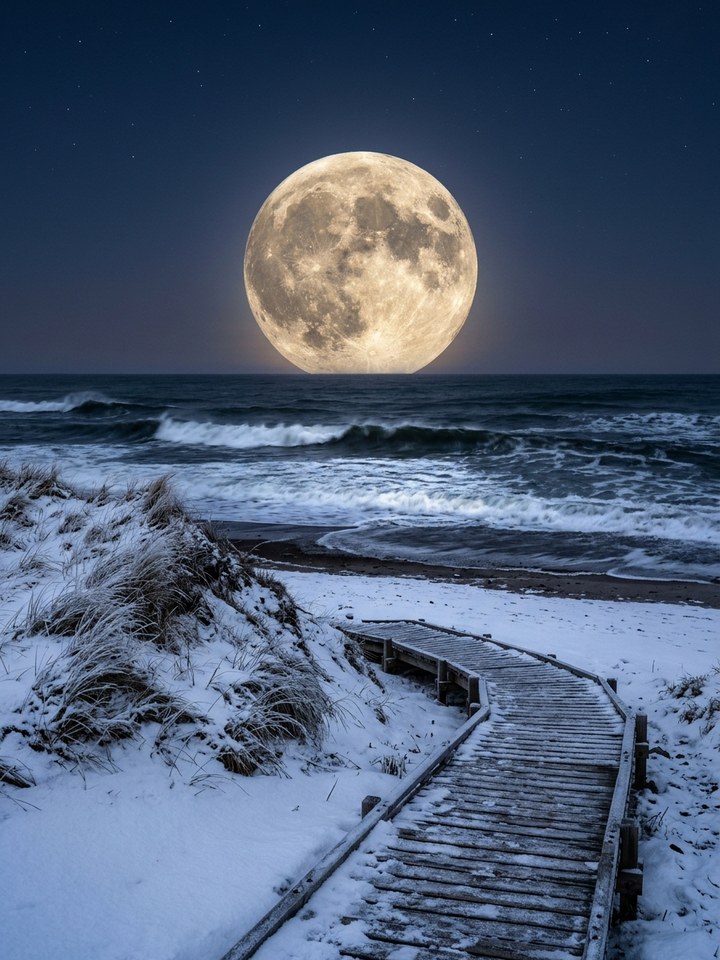
December 2026 Cold Supermoon & US King Tides Viewing Guide
By Sustainability Awakening • Dr. Ahmad Mahmood
CLOSEST 2026 SUPERMOON
Full Crest: Dec 23 at 8:28 PM EST
NASA & USNO ephemeris place full phase at 01:28 UTC Dec 24 (5:28 PM PST Dec 23 across the West).
221,667-MILE PERIGEE
356,740 km: Closest Moon of 2026
Lunar perigee arrives 7 hours later (08:31 UTC Dec 24), appearing ~7% larger and ~15% brighter.
DEC 21 WINTER SOLSTICE
Longest US Night Meets Full Moon
On Dec 21 at 3:50 PM EST (20:50 UTC), Northern Hemisphere daylight hits its ~9h 15m 40°N minimum.
ORBITAL GEOMETRY
Highest Overhead Moon Arc of 2026
Opposite the low solstice Sun (23.44°S), the Cold Supermoon climbs higher overhead than any 2026 moon.
DEC 21–22 URSID PEAK
Ursid Meteors Face 95% Moon Glare
Comet 8P/Tuttle peaks Dec 22 (~10 meteors/hr ZHR), but bright supermoon glare hides faint streaks.
NOAA TIDAL PHYSICS
Perigee + Syzygy Drive King Tides
Close lunar perigee plus Earth nearing January perihelion amplifies solar-lunar tidal pull Dec 23–26.
DEC 23–26 COASTAL WATCH
+0.5 to 1.5 Ft Above Normal Highs
Low-lying streets in Miami, Charleston, Norfolk, Boston, SF Bay, and Seattle face sunny-day flooding.
CLIMATE BASELINE SHIFT
8–12 Inches of US Sea-Level Rise
NOAA tide gauges record 8–12 in. of US coastal rise since 1950, turning routine king tides into floods.
US VIEWING STRATEGY
Watch Moonrise East at Sunset
Look ENE 15–25 minutes after local sunset on Dec 23 for warm horizon glow and crisp foreground scale.
2026–2027 US SKY GUIDE
See Every 2026–2027 US Sky Event
Check peak dates for meteor showers, eclipses, and aurora storms.