Global Water Bankruptcy: Why the Era of “Crisis” is Over
Published on January 28, 2026 by Dr. A. M.
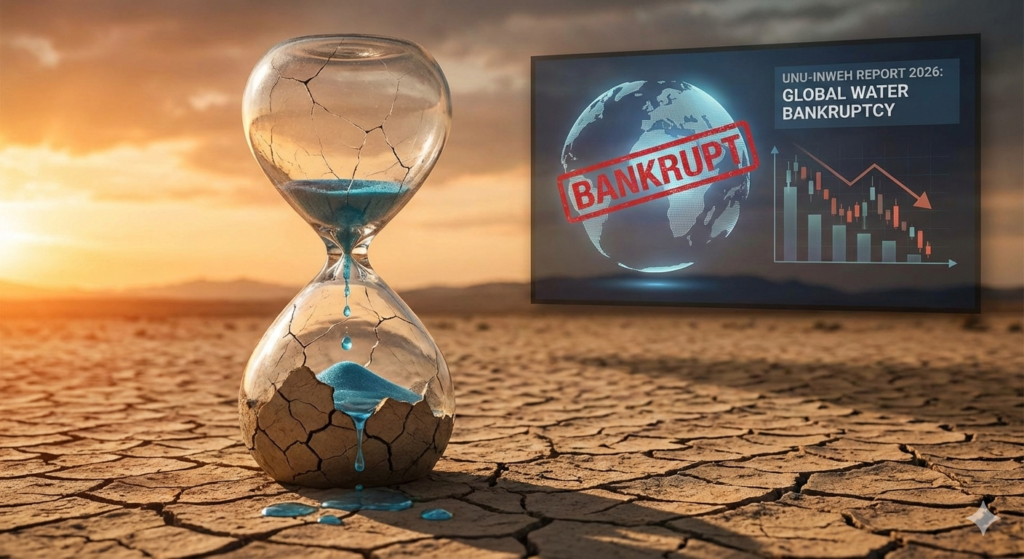
For the last thirty years, the global environmental community has rallied around a single, urgent phrase: “The Global Water Crisis.” It appears in headlines, NGO reports, and government policies.
However, a landmark flagship report released this week by the United Nations University Institute for Water, Environment and Health (UNU-INWEH) argues that this terminology is now dangerously obsolete. The report, titled “Global Water Bankruptcy: Living Beyond Our Hydrological Means in the Post-Crisis Era,” declares that we have crossed a threshold.
We are no longer in a “crisis”—a term that implies a temporary shock with a eventual return to stability. We have entered Water Bankruptcy, a permanent state of insolvency where our hydrological assets can no longer cover our systemic debts.
The Paradigm Shift: Crisis vs. Bankruptcy
To understand the severity of this report, we must understand the economic metaphor at its core.
- A “Crisis” (Liquidity Issue): In financial terms, a liquidity crisis is temporary. You might be short on cash today, but your business model is sound. With a loan or a temporary belt-tightening, you can bounce back. This is how we have treated droughts for decades—as temporary anomalies.
- “Bankruptcy” (Solvency Issue): Bankruptcy happens when your liabilities exceed your assets permanently. You have spent more than you earned for so long that your savings are gone, and your income streams have dried up.
The UNU-INWEH report argues that many river basins and aquifers have reached this point. They have lost the ability to return to their “historical normal”. The droughts we face today are not temporary shocks; they are chronic symptoms of a broken system.
The Balance Sheet: Losing Our “Natural Capital”
If the world is a business, our “Natural Capital” is the infrastructure that produces and stores water. The report explicitly identifies the assets we are liquidating:
- Aquifers: Our long-term savings accounts, now being drained faster than they recharge.
- Glaciers: The frozen reservoirs that feed our rivers, now melting away.
- Wetlands & Soils: The natural filters and sponges that regulate flow, now paved over or degraded.
When these assets are destroyed, the system loses its resilience. A rainstorm that used to refill an aquifer now causes a flood because the soil is degraded. We haven’t just used the water; we have broken the machine that makes it available.
The Solution: “Bankruptcy Management”
The most radical part of the report is its call to action. It urges policymakers to stop “crisis management” (reacting to emergencies) and start “Bankruptcy Management”.
What does this look like in practice? The report outlines three non-negotiable pillars:
1. Transparent Water Accounting
You cannot fix a bankrupt company if you cook the books. Similarly, nations must implement rigorous, transparent accounting of water resources. We need to know exactly:
- How much water is actually available?
- Who is taking it?
- Where are the “hidden debts” (illegal extraction or pollution)?
2. Enforceable Limits
In a bankruptcy hearing, a judge sets strict limits on spending. The report argues for enforceable limits on water use to stop the “overshoot”. Voluntary conservation is no longer sufficient; hard caps are required to prevent total systemic collapse.
3. Equity-Oriented Transitions
Bankruptcy restructuring is painful. Usually, the poorest employees suffer the most. The report emphasizes that water transitions must be explicitly equity-oriented. We must protect vulnerable communities and livelihoods during the difficult process of cutting back water usage.
A Strategic Opportunity in a Fragmented World
Despite the grim terminology, Dr. Kaveh Madani and the UNU-INWEH authors frame this as a strategic opportunity.
Acknowledging bankruptcy is the first step toward recovery. By accepting that the “old normal” is gone, we can stop wasting money on temporary fixes and start investing in long-term restructuring. The report argues that serious investment in water can unlock progress across multiple sectors:
- Climate Resilience: Restored wetlands buffer against storms.
- Biodiversity: Healthy rivers support life.
- Food & Health: Sustainable aquifers ensure long-term food security.
Conclusion: The Post-Crisis Reality
As we look toward the 2026 UN Water Conference, the language is changing. The warning is clear: If we continue to treat chronic water failure as a temporary crisis, we will face total collapse. But if we have the courage to declare bankruptcy—to admit we are living beyond our means—we can start the hard work of rebuilding our natural capital.