El Niño Outlook 2026: ENSO Forecast, Transition Timeline, and Global Risks
Published on February 27, 2026 by Dr. A. M.

The El Niño outlook 2026 signals a major transition in the Pacific climate system after an extended period of La Niña influence. As of mid February 2026, oceanic and atmospheric indicators show weakening La Niña conditions and a rapid move toward ENSO neutral, with increasing odds of El Niño by late summer.
According to the latest diagnostics from the National Oceanic and Atmospheric Administration and the North American Multi-Model Ensemble, subsurface warming is accelerating across the equatorial Pacific. This shift has direct implications for agriculture, energy markets, water management, disaster preparedness, and global commodity flows.
Understanding the El Niño outlook 2026 is therefore essential for risk planning across climate sensitive sectors.
Key Scientific Foundation Behind the El Niño Outlook 2026
What Is ENSO and Why It Matters
The El Niño Southern Oscillation, or ENSO, is the dominant driver of year to year climate variability. It operates through ocean atmosphere coupling in the tropical Pacific and has three phases:
- El Niño: Warmer than average sea surface temperatures in the central and eastern Pacific
- La Niña: Cooler than average sea surface temperatures
- ENSO neutral: Near average ocean conditions
Forecasters monitor the Niño 3.4 region, located between 120W and 170W along the equator. Sustained anomalies above or below ±0.5°C typically define ENSO phases.
Current Conditions: The Decline of La Niña
La Niña persisted through January 2026 but is weakening.
Recent measurements show:
- Niño 3.4 index: -0.9°C
- Niño 4 index: -0.4°C
- Niño 1+2 index: 0.0°C
- Traditional and equatorial Southern Oscillation Index values: Positive
However, the most important signal is subsurface warming. The equatorial subsurface temperature index, averaged from 180° to 100°W, has increased significantly. Warm water is expanding eastward beneath the surface, eroding the cold pool that sustains La Niña.
Atmospheric anomalies are also fading:
- Low level westerly wind anomalies over the western Pacific
- Upper level westerly wind anomalies across the east central Pacific
- Suppressed convection near the Date Line weakening due to subseasonal variability
Collectively, the coupled ocean atmosphere system still reflects weak La Niña conditions, but the transition is clearly underway.
2026 ENSO Forecast Timeline and Probabilities
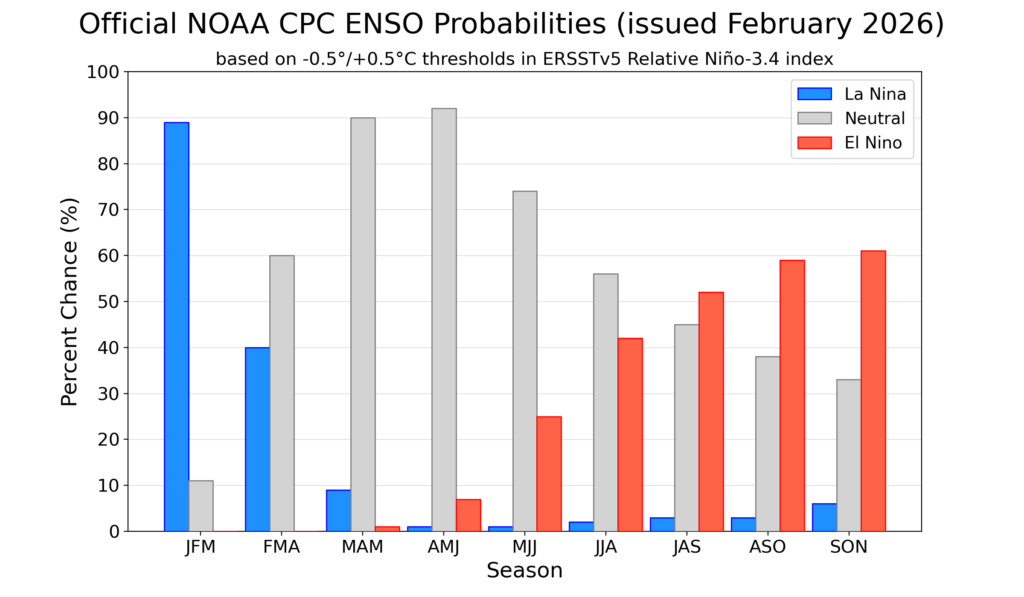
Both the CCSR IRI ENSO plume and NMME consensus indicate a rapid shift toward neutral conditions, followed by a rising probability of El Niño.
Forecast Probabilities for Early and Mid 2026
| 2026 Timeframe | La Niña | ENSO Neutral | El Niño |
|---|---|---|---|
| Feb to Apr | 4% | 96% | Near 0% |
| Mar to May | Minimal | 90% | Rising |
| Apr to Jun | Minimal | 65% | ~30% |
| May to Jul | Minimal | ~35% | 58% to 61% |
Key insights from the El Niño outlook 2026:
- ENSO neutral is highly likely through spring
- Neutral persists into early summer
- El Niño probabilities rise sharply from May onward
- Late summer shows a 50% to 60% chance of El Niño formation
Forecasts issued during spring face lower skill due to the well known spring predictability barrier. However, the strength and expansion of subsurface warming provide moderate confidence in a warming trajectory.
What to Expect in Spring and Summer 2026
The Arrival of ENSO Neutral
A formal transition to ENSO neutral between February and April 2026 carries roughly 60% probability based on NMME averages.
During ENSO neutral periods:
- Global weather patterns become more regionally driven
- Short term variability dominates
- Tropical cyclone activity may respond more to Atlantic and Indian Ocean signals
However, neutral does not mean stable. Transitional phases often feature atmospheric volatility.
The Potential Return of El Niño
By late summer 2026, the El Niño outlook 2026 increasingly favors a warming event.
If El Niño develops, we can expect:
- Enhanced rainfall across parts of the southern United States
- Drier conditions in Australia and Indonesia
- Elevated wildfire risk in some subtropical regions
- Increased coral bleaching risk
- Changes in global hurricane basin behavior
These shifts would influence food supply chains, energy demand, and disaster preparedness planning.
Environmental and Economic Impacts
ENSO transitions have cascading consequences.
Hydrological and Temperature Effects
El Niño years often produce:
- Above average global surface temperatures
- Shifts in monsoon intensity
- Flood risk increases in some regions
- Drought intensification in others
Global mean temperature anomalies frequently spike during El Niño years due to enhanced ocean heat release.
Agriculture and Food Security
Potential agricultural impacts include:
- Reduced wheat yields in Australia
- Stress on rice production in Southeast Asia
- Fisheries disruption off Peru due to suppressed upwelling
- Commodity price volatility
Given tight global grain stocks, even moderate production losses can amplify inflation.
Energy and Insurance Markets
El Niño influences:
- Hydropower generation variability
- Natural gas demand shifts
- Insurance loss exposure from floods and droughts
The El Niño outlook 2026 therefore carries implications beyond meteorology. It intersects directly with macroeconomic stability.
Monitoring and Institutional Tracking
Weekly oceanic and atmospheric conditions are monitored by the Climate Prediction Center.
Updated ENSO diagnostics, plume forecasts, and probabilistic strength outlooks are released regularly. The next ENSO Diagnostics Discussion is scheduled for March 12, 2026.
Continuous monitoring is critical because:
- Subsurface heat content can accelerate surface warming
- Westerly wind bursts can trigger rapid phase shifts
- Model spread can narrow quickly as summer approaches
Stakeholders should track updates rather than rely on a single forecast release.
Challenges and Forecast Uncertainty
While the El Niño outlook 2026 shows rising probabilities, several constraints remain.
Spring Predictability Barrier
Forecast accuracy historically drops between March and May. Ocean atmosphere coupling is less stable during this window.
Model Spread
Although ensemble averages show 50% to 60% probability of El Niño by late summer, individual models vary.
Climate Change Interaction
Long term warming may intensify rainfall extremes and marine heatwaves during El Niño events. However, attribution remains complex.
Strategic Risk Management for 2026
Given the projected transition, proactive planning is prudent.
Government Level Actions
- Integrate ENSO probabilities into national adaptation strategies
- Pre position drought and flood response funds
- Update seasonal agricultural advisories
- Strengthen early warning systems
Private Sector Planning
- Conduct climate stress tests on supply chains
- Hedge commodity exposure where relevant
- Increase climate risk disclosure transparency
- Diversify sourcing in ENSO sensitive regions
Community Preparedness
- Monitor regional seasonal outlooks
- Enhance water conservation planning
- Prepare for flood or drought contingencies
Early action significantly reduces economic losses.
Frequently Asked Questions
Is El Niño likely in 2026?
Yes. The El Niño outlook 2026 shows a 50% to 60% probability of El Niño forming by late summer, following a transition to ENSO neutral in early 2026.
Why is subsurface warming important?
Subsurface heat buildup often precedes surface warming. Expanding warm anomalies below the surface increase the likelihood of El Niño development.
How could El Niño affect hurricane seasons?
El Niño typically suppresses Atlantic hurricane activity but can enhance activity in the central and eastern Pacific.
How reliable are spring ENSO forecasts?
Forecast reliability is lower in spring due to the spring predictability barrier. Confidence improves by early summer.
Conclusion
The El Niño outlook 2026 reflects a decisive shift away from prolonged La Niña conditions toward ENSO neutral in spring, with a rising probability of El Niño by late summer.
Subsurface warming, weakening atmospheric anomalies, and multi model consensus all support this trajectory. Although uncertainty remains due to the spring predictability barrier, the risk signal is strong enough to justify preparedness planning.
Climate sensitive sectors should integrate updated ENSO diagnostics into operational decisions throughout 2026. Monitoring developments over the next several months will be critical to refining risk projections and minimizing economic disruption.