
2026 US Drought: 5 Shocking Drivers of the Crisis
The climatological data for April 2026 has confirmed a catastrophic milestone for the North American continent. The 2026 US Drought has officially registered as the most severe early-season desiccation event in recorded history. Data from the National Oceanic and Atmospheric Administration (NOAA) reveals that the contiguous United States Palmer Drought Severity Index (PDSI) plummeted past -6.00. To put this in perspective, this reading is worse than the peak of the July 1934 Dust Bowl, an event that reshaped American agriculture and economics for a generation.
We are witnessing the rapid unraveling of predictable hydrological cycles. With over 61% of the Lower 48 states trapped in moderate to exceptional drought, and an unprecedented 97% of the American Southeast parched, the crisis transcends regional weather variations. This is a systemic atmospheric reorganization.
Table of Contents
The 2026 US Drought: Analyzing the PDSI Collapse
The Palmer Drought Severity Index (PDSI) is the meteorological gold standard for measuring relative soil moisture, balancing precipitation inputs against temperature-driven evapotranspiration outputs. A PDSI reading of -4.0 designates extreme drought. The April 2026 reading crossing the -6.00 threshold indicates a complete evaporation of topsoil moisture reserves.
The mainstream narrative frequently attributes this to localized weather patterns or temporary blocking highs. However, the contrarian reality—and the predictive insight for the 2030s—is that the 2026 US Drought is not a temporary anomaly. It is the new climatological baseline. The mid-latitude westerlies and subtropical high-pressure systems are fundamentally shifting, effectively locking the contiguous United States into a state of structural aridity. The traditional metrics of “hydrological recovery” are now mathematically obsolete.
Surpassing the Dust Bowl: The Climate Context
Comparing 2026 to the 1930s reveals a sinister evolution. The Dust Bowl was heavily exacerbated by poor land management—specifically, the over-plowing of deep-rooted native prairie grasses. Today, despite advanced precision agriculture and modern soil conservation practices, we are losing the battle against escalating extreme heat stress. Thermal atmospheric expansion is accelerating evapotranspiration at a rate that outpaces any localized rainfall, ensuring that even average precipitation years yield net-negative soil moisture.
Systemic Ripple Effects: Beyond the Soil
The 2026 US Drought is acting as a threat multiplier across three critical pillars of society: agriculture, surface water reserves, and subterranean aquifers.
1. The Agricultural and Food Price Shock
Farmers are currently facing failed winter wheat crops and severely restricted surface water allotments for the summer. When soil moisture evaporates at this velocity, the biological microbiome of the earth dies off, requiring an urgent transition to climate-resilient agriculture. If global food supply chains cannot absorb this American deficit, expect severe inflationary spikes in grain, meat, and consumer staples by Q3 of 2026.
2. The Colorado River and Surface Water Collapse
The Colorado River basin’s chronic shortages are moving past the point of negotiation. With Lakes Mead and Powell already operating at historically perilous levels, the lack of spring snowmelt in 2026 ensures that major hydroelectric systems and agricultural diversions face catastrophic operational curtailments.
3. The Accelerated Groundwater Trap
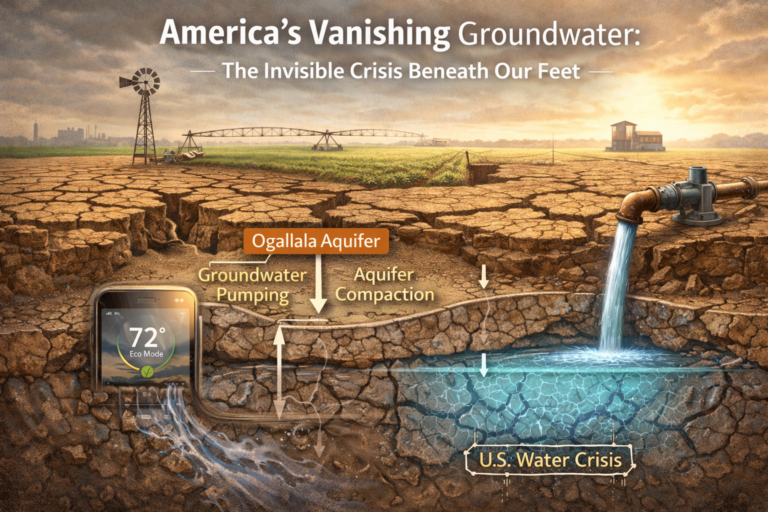
To compensate for the lack of rainfall and surface water, agricultural operations are drastically increasing aquifer pumping. America’s accelerating groundwater depletion is causing land subsidence and permanently destroying the storage capacity of aquifers. We are mortgaging our geological future to survive the current season.
Data Benchmarks: Measuring the Unprecedented
| Drought Event | Peak Month | PDSI Metric | Systemic Driver |
|---|---|---|---|
| 2026 US Drought | April 2026 | < -6.00 | Anthropogenic warming & structural precipitation deficits |
| The Dust Bowl | July 1934 | -5.96 | Poor soil management & La Niña cycle |
| The 1950s Drought | October 1956 | -5.24 | Prolonged La Niña anomaly |
Actionable Intelligence: Navigating the New Aridity
To survive the economic and ecological fallout of the 2026 US Drought, stakeholders must pivot from reactive emergency management to proactive systemic adaptation.
- Implement Precision Managed Aquifer Recharge (MAR): States and agricultural conglomerates must heavily invest in infrastructure that captures extreme precipitation events (when they do occur) and physically injects water back into depleted aquifers, rather than allowing it to run off.
- Adopt Bio-Stimulant Soil Networks: Transition away from synthetic fertilizers which degrade soil structure. Mandate the integration of biochar and mycorrhizal fungi networks into industrial farming to radically increase the water-holding capacity of existing topsoil.
- Re-evaluate ESG Water Risk Benchmarks: Financial institutions must aggressively update their Scope 3 emissions and water risk models. Companies heavily reliant on water-intensive supply chains in the American West and Southeast should be graded on their immediate transition to closed-loop water recycling systems.